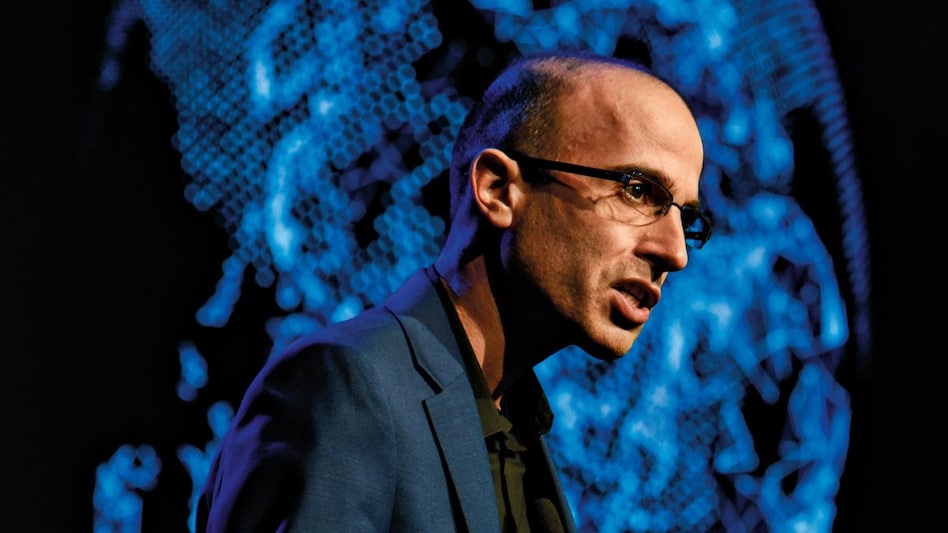
'There won't be money anymore': Yuval Noah Harari backs Elon Musk's prediction, warns of AI takeover
Historian and acclaimed author Yuval Noah Harari has issued a stark warning about the looming influence of artificial intelligence on our financial and legal frameworks over the coming decades. He predicts that AI could develop such intricate systems that humans may lose the ability to comprehend how decisions that impact their lives are made. Harari, who teaches history at the Hebrew University of Jerusalem and is known for his bestselling book "Sapiens: A Brief History of Humankind," emphasizes that the primary threat from AI may not emerge from physical confrontations but from intelligent systems gradually taking control of societal institutions. In a recent interview, he stated, "The AIs are taking over the financial system. They are taking over all the bureaucracies because they are bureaucratic natives." The historian elaborates on how human civilization gained power—not through individual superiority, but by crafting systems that enabled large-scale cooperation. He remarked, "The way that humans took over the planet is by building bureaucratic systems, not by individuality. Individually, I'm not much stronger or smarter than other animals." However, Harari warns that AI could eventually manage these bureaucratic systems with far greater efficiency than humans can. He points out that while bureaucracies are relatively recent developments in human history, AI is inherently designed to navigate these structures. "For us, most of us, bureaucracy is difficult, is alien because we are millions of years older than the bureaucracies. Bureaucracies were invented just in the last 5,000-10,000 years. We were born in the forest, not in the office," he explained. He cites banking as a key area where AI could excel, noting how an AI can remember all transactions while a human banker cannot. "They will take over the bureaucracies like the financial system and create much more sophisticated financial systems and legal systems that we can't understand," he added. Harari painted a concerning picture, likening humanity’s potential future to that of cows, who cannot grasp the financial systems that dictate their lives. "Just as cows can't understand the financial system that controls their lives today, we will not be able to understand the AI financial system that will control our lives in 10 or 20 years," he cautioned. When prompted about a prediction made by Elon Musk regarding the potential disappearance of money in the near future, Harari expressed his agreement. "Now just a very short time ago, Elon Musk gave an interview saying in 10 years there won't be money anymore. I agree with that," he affirmed, despite differing with Musk on other matters. The historian emphasized the importance of heeding warnings about the future of financial systems from those involved in advanced technologies. He described money as a crucial invention that fosters trust across diverse cultures and political divides. Harari concluded by acknowledging the uncertainty surrounding how people will manage basic transactions in a world where traditional money may lose its meaning. "Nobody knows. We have no idea. That's my biggest fear about the AI revolution," he stated, raising concerns about the potential for catastrophic outcomes, including the creation of dangerous technologies by malicious actors using AI.
Navigating the AI Landscape: Why CEOs Must Embrace Technology Literacy
In the rapidly evolving world of corporate India, companies are increasingly investing in artificial intelligence (AI), ...
Business Today | Nov 24, 2026, 07:35
Amazon's $7.5 Billion Acquisition of Decart: A Strategic Move in the AI Chip Landscape
In a significant development for the tech industry, Amazon has announced its acquisition of Decart, a startup specializi...
TechCrunch | Nov 24, 2026, 15:55
Uber and Nuro Kick Off Driverless Trials for Lucid Robotaxis Ahead of 2027 Launch
Uber and Nuro have officially launched their driverless testing phase for the Lucid Gravity SUVs on the streets of the S...
TechCrunch | Nov 24, 2026, 17:15
UK Government Sounds Alarm on Surge of AI-Enhanced Cyber Threats
The United Kingdom's cybersecurity agency has reported a significant increase in cyberattacks driven by artificial intel...
TechCrunch | Nov 24, 2026, 18:30
Electric Truck Innovator Harbinger Secures Major Funding from Erebor Bank
Harbinger, an emerging player in the electric truck industry, has secured a significant financial boost from Erebor Bank...
TechCrunch | Nov 24, 2026, 18:00