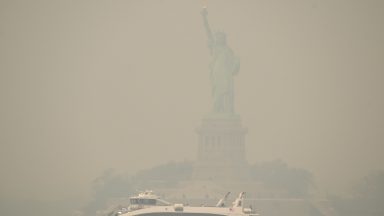
Wildfires are challenging air quality monitoring infrastructure
A decade ago, Tracey Holloway, an atmospheric scientist from the University of Wisconsin–Madison, viewed air pollution trends in the United States as a significant success. "Air quality was improving consistently across the board," she noted. However, in June 2023, the situation took a turn when smoke from Canadian wildfires caused air quality to plummet to alarmingly low levels in Wisconsin. Just last month, the air quality deteriorated once again, primarily due to wildfires. Despite the substantial efforts to reduce pollution from vehicles and industrial sources through strict emission regulations, the growing frequency and severity of wildfires are undermining these achievements. Nga Lee “Sally” Ng, an aerosol researcher at the Georgia Institute of Technology, emphasized that the rise in wildfire incidents is "erasing the gains that we have obtained through this pollutant control effort." This evolving landscape poses significant challenges for both residents and scientists monitoring air quality. Many of the advanced pollution sensors are strategically placed near major cities and industrial sites, leaving numerous areas—known as air quality monitoring deserts—without adequate coverage. This lack of monitoring can leave vulnerable communities unaware of their air quality status. Moreover, the existing monitoring infrastructure struggles to adapt to the unpredictable nature of wildfire smoke, which can travel vast distances from its source, impacting air quality and public health far beyond the immediate vicinity of the fires. The smoke can also carry hazardous substances, including lead, particularly when urban areas are affected by wildfires. Holloway remarked, "Fires are really changing the story." Since the Air Pollution Control Act of 1955, air quality has been a recognized national concern in the U.S. The enactment of the Clean Air Act in 1970 and its subsequent amendments spurred monitoring efforts to assess pollutants like carbon monoxide, nitrogen dioxide, ozone, particulate matter, and sulfur dioxide against established National Ambient Air Quality Standards. The current challenges underscore the need for an updated approach to air quality monitoring in the face of changing environmental conditions.
Navigating Pentagon Relations: A Strategic Playbook for Tech CEOs
In a surprising move, the Pentagon has blacklisted Anthropic, the AI startup founded by Dario Amodei, citing supply chai...
Business Insider | Mar 08, 2026, 15:40The New Age of Online Access: Balancing Child Safety and Privacy Concerns
Recent U.S. legislation aimed at safeguarding minors is inadvertently dragging millions of adults into mandatory age-ver...
CNBC | Mar 08, 2026, 15:00
Navigating the Memory Crisis: Insights from Framework's CEO on Surviving Supply Challenges
The ongoing memory shortage is significantly impacting the cost of manufacturing consumer electronics. In this challengi...
Business Insider | Mar 08, 2026, 09:00Rivian's Bold Strategy: Racing Towards R2 Launch Amidst Competitive Landscape
In the ever-evolving realm of transportation technology, Rivian is gearing up for a significant moment as it prepares to...
TechCrunch | Mar 08, 2026, 16:35
AI Data Centers Spark Demand for Temporary Worker Villages
In response to the increasing need for a workforce to support the construction of AI data centers, developers are turnin...
TechCrunch | Mar 08, 2026, 17:00