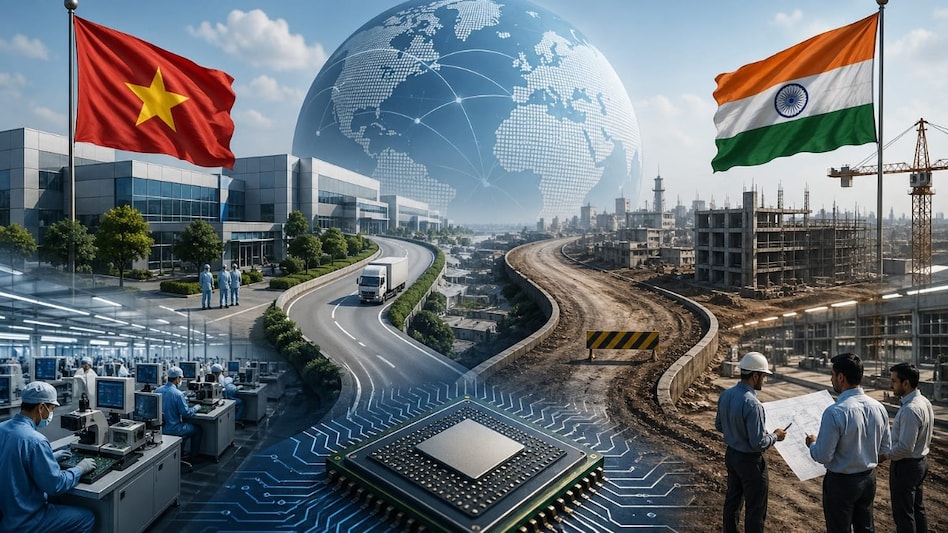
Vietnam is winning the chip race India wanted to lead
India has been actively promoting the establishment of a semiconductor ecosystem, offering significant incentives and clearing proposals. However, many global investors are gravitating towards Vietnam instead. Major chip manufacturers like Intel and Samsung Electronics have identified Vietnam as a prime location for expanding their semiconductor packaging operations. Intel has significantly enhanced its assembly, testing, and packaging (ATMP) capabilities in Vietnam, establishing one of its largest facilities in the nation. Although Samsung has yet to make a formal announcement, it is reportedly in discussions to build a multibillion-dollar chip packaging unit in Vietnam. In contrast, India is pursuing similar initiatives through the India Semiconductor Mission and has secured a noteworthy investment from Micron Technology. Yet, apart from Micron, the presence of large global chipmakers in India remains limited. This raises an important question: Why is Vietnam managing to transform its intentions into substantial investments at a quicker pace than India? Vietnam's advantages are not new but stem from years of consistent policy development and implementation. While Vietnam was not as early as Malaysia in semiconductor manufacturing, it took earlier steps than India in the back-end production of electronics-driven semiconductors. Intel launched its assembly and testing facility in Vietnam back in 2006, completing it by 2010 and subsequently increasing its investment. Samsung entered the Vietnamese market in 2008, establishing a massive electronics manufacturing base. This has provided Vietnam with a significant 15-20 year head start in terms of infrastructure, export logistics, skilled labor, and government support for large foreign direct investments (FDI). Vietnam has successfully created a robust ecosystem of suppliers, skilled workforce, and export infrastructure, all vital components for semiconductor packaging. While India offers attractive financial incentives, with the government providing up to 50% capital support and states contributing an additional 20-25%, experts argue that financial incentives alone do not guarantee success. Vietnam’s High-Tech Incentives Law provides semiconductor companies with advantageous tax rates, such as a 10% corporate income tax (CIT) for 15 years, along with extensive tax holidays for major projects. In addition, Vietnam offers exemptions on land rent lasting up to 22 years and support for training and research and development, which further reduces long-term operational costs. For chip manufacturers, the speed of execution and reliability often outweigh the appeal of financial incentives. Many believe that in Vietnam, processes tend to function as expected, with facilities being constructed, suppliers appearing, and shipments occurring on schedule. Vietnam's industrial zones, like Saigon Hi-Tech Park and Hoa Lac Hi-Tech Park, provide integrated environments where land, approvals, utilities, and logistics are streamlined. This readiness creates an appealing scenario for investors, facilitating a smoother establishment of operations. For semiconductor packaging, having a plant is only part of the equation; the surrounding ecosystem is crucial. An existing electronics manufacturing infrastructure is essential for attracting investments in chip packaging, as these packaged chips are necessary components for electronic devices. Companies often prefer to locate these facilities near their production sites to minimize logistics costs and delays. Vietnam enjoys geographic advantages, being close to China and integrated into East Asian supply chains. Additionally, as a member of ASEAN with free trade agreements with the EU, Japan, and South Korea, it benefits from duty-free movement of components, which is essential in the low-margin ATMP sector. While India's electronics manufacturing capabilities have improved significantly over the past decade and its design talent is among the best in the world, the semiconductor packaging ecosystem is still developing. India's ambition to become a semiconductor hub is evident, but the execution of its plans has been inconsistent. Delays caused by complex approval processes, coordination issues, and infrastructure challenges continue to impede progress. In a field where rapid market entry is crucial, this execution gap could hinder India's ability to attract further investments, pushing them toward ecosystems that are already thriving.
Kalshi Challenges Netflix Over Controversial Documentary Trailer
Kalshi, the prediction market platform, has taken significant legal steps against Netflix, sending a cease-and-desist le...
TechCrunch | Jul 25, 2026, 17:10
Unleashing the Power of AI: The 5 Smartphones Redefining Mobile Photography
Artificial Intelligence (AI) is transforming our daily experiences, permeating various aspects of technology, including ...
Business Today | Jul 26, 2026, 07:05
Finland Unveils World's Largest Sand Battery to Tackle Renewable Energy Challenges
In a groundbreaking move to address the critical issue of renewable energy intermittency, a small town in southern Finla...
CNBC | Jul 25, 2026, 05:35
OpenAI's Micro Keypad: A Novelty for Coders or Just a Confounding Gadget?
Last week, OpenAI made its debut in the hardware landscape with the launch of Micro, a stylish keypad designed to integr...
TechCrunch | Jul 25, 2026, 24:40
Warner Bros. Takes Legal Action Against Amazon Over Executive Poaching Allegations
Warner Bros. Discovery has initiated legal proceedings against Amazon, accusing the tech giant of unlawful interference ...
TechCrunch | Jul 25, 2026, 21:25