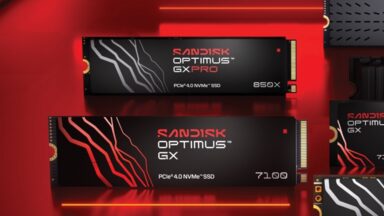
SanDisk says goodbye to WD Blue and Black SSDs, hello to new “Optimus” drives
In a significant shift within the storage industry, Western Digital has announced a major rebranding of its solid-state drives. As part of a strategic split, the company will separate its operations into two distinct entities: one retaining the Western Digital name, focusing on traditional spinning hard drives, and the other adopting the SanDisk brand, dedicated to solid-state storage solutions. The rebranding marks the end of the WD Blue and WD Black SSDs, which have been staples in the consumer market. They will now be replaced by the newly minted SanDisk Optimus series. The Optimus line will retain the familiar model identifiers, but with fresh branding. For instance, the WD Blue drives will now be known as "SanDisk Optimus" drives, starting with the Optimus 5100, which is essentially a rebranded version of the WD Blue SN5100. Similarly, the mid-tier WD Black drives will transition to the "SanDisk Optimus GX" branding, with the Optimus GX 7100 taking over from the WD Black SN7100. For high-end users, the premium WD Black drives will evolve into the "SanDisk Optimus GX Pro" series, featuring the Optimus GX Pro 850X and 8100, which replace the WD Black SN850X and 8100 models. While these new drives are built on fast NVMe technology, users may find it challenging to discern differences between the entry-level Blue/Optimus and the high-end Black/Optimus GX Pro SSDs. However, the underlying technology remains consistent: the Optimus 5100 is powered by quad-level cell (QLC) flash memory, whereas the Optimus GX 7100 utilizes triple-level cell (TLC) memory. For those seeking maximum performance, the Optimus GX Pro 8100 features a cutting-edge PCIe 5.0 interface and a dedicated DRAM cache. In contrast, the Optimus 5100 and 7100 utilize a portion of the system's RAM for this function, known as the Host Memory Buffer (HMB). The older Optimus 850X, while still equipped with dedicated DRAM, is restricted to PCIe 4.0 speeds. As these changes roll out, consumers can expect a fresh take on familiar products, all while maintaining the performance standards they have come to trust from Western Digital and SanDisk.
Volkswagen Engineers Indicted for Insider Trading Linked to Rivian Partnership
In a significant legal development, the U.S. Department of Justice has brought securities fraud charges against two engi...
TechCrunch | Jul 24, 2026, 20:30
Legal Battle Erupts Over 'Duress' Password in Groundbreaking Data Wiping Case
The U.S. Justice Department has initiated legal proceedings against a Georgia resident, Samuel Tunick, who is accused of...
TechCrunch | Jul 24, 2026, 18:25
India's Crackdown on Open-Source Messaging App Raises Legal Concerns
The Indian government's recent initiative to enforce restrictions on Jack Dorsey's offline Bluetooth messaging applicati...
TechCrunch | Jul 24, 2026, 17:10
Anthropic Unveils Claude Opus 5: A Game-Changer in Cost-Effective AI
Anthropic has officially launched its latest AI model, Claude Opus 5, which the company claims is its most efficient and...
CNBC | Jul 24, 2026, 17:20
The High Stakes of Young Entrepreneurship: Balancing Ambition and Pressure
At just 19, Arlan Rakhmetzhanov embodies the relentless spirit of youth entrepreneurship. He believes there’s no in-betw...
TechCrunch | Jul 24, 2026, 17:40