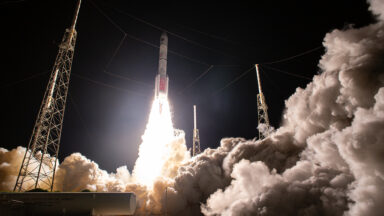
After first operational launch, here’s the next big test for ULA’s Vulcan rocket
The United Launch Alliance (ULA) has made a significant leap in its operational capabilities with the successful launch of multiple US military satellites into high-altitude orbit. This launch, which took place during prime time on Tuesday night, represents a pivotal shift from the development phase to operational readiness for ULA's cutting-edge Vulcan rocket. Designated as USSF-106 by the US Space Force, this mission marks Vulcan's inaugural flight carrying national security payloads. Following two test flights conducted last year, military officials expressed confidence in certifying the rocket for the Pentagon's medium-to-large space missions. The 202-foot-tall (61.6-meter) Vulcan rocket lifted off from Cape Canaveral Space Force Station, Florida, at 8:56 PM EDT (00:56 UTC Wednesday). Fueled by two BE-4 main engines, designed by Blue Origin, and four solid-fueled boosters from Northrop Grumman, the rocket generated nearly 3 million pounds of thrust as it departed the launch pad. As the rocket ascended into the atmosphere, it successfully jettisoned its four strap-on boosters, core stage, and payload fairing, which fell into the Atlantic Ocean. The Vulcan's Centaur upper stage then ignited its RL10 engines multiple times to navigate into a nearly circular geosynchronous orbit, over 22,000 miles (approximately 36,000 kilometers) above the equator. This intricate series of maneuvers took roughly seven hours, culminating in the release of its payloads into space. Among the satellites launched was an experimental platform aimed at testing next-generation technologies to enhance GPS navigation. While the Space Force has not disclosed details about additional satellites aboard the rocket, it is known that there were at least one or more hidden payloads. Following the successful mission, ULA and Space Force officials celebrated the Vulcan rocket's operational debut. This accomplishment marks the beginning of ULA's ambitious journey to fulfill a firm backlog of over 70 Vulcan launches already contracted. Most of these launches are secured through the Space Force's National Security Space Launch (NSSL) program and Amazon's Kuiper satellite broadband initiative. Col. Jim Horne, the mission director for USSF-106, expressed pride in the successful launch, stating, "It’s an exciting day for us as we launched the first NSSL flight of Vulcan, an outstanding achievement for United Launch Alliance and the nation’s strategic space lift capability. This is an important milestone for the Space Force and all involved." He added, "After years of development, technical collaboration, and dedication by all involved, including our government mission partners and the entire ULA team, I’m proud to say the first Vulcan NSSL mission delivered its payloads safely into space."
Spotify's Daniel Ek Secures $700 Million for Revolutionary Health Startup Neko Health
Neko Health, the innovative body-scanning and health assessment firm co-founded by Spotify's Daniel Ek and Hjalmar Nilso...
TechCrunch | Jul 15, 2026, 20:05
Microsoft Bolsters Security with Critical Patch for Age of Empires II Vulnerability
Microsoft recently rolled out a significant security update, addressing a record number of vulnerabilities across its pr...
TechCrunch | Jul 15, 2026, 19:25
Anthropic Gears Up for Potential IPO as Investor Interest Grows
Anthropic is making significant strides towards a potential initial public offering (IPO) as it organizes meetings with ...
CNBC | Jul 15, 2026, 17:30
OnePlus to Scale Back Operations in US and Europe Amid Market Challenges
In response to rising prices in the consumer electronics market and a slowdown in demand, OnePlus, the Android phone man...
TechCrunch | Jul 15, 2026, 18:05
Apple's Maps Advertising Strategy: A Distinct Approach from Google's
Apple has discreetly introduced guidelines for its forthcoming Maps advertising, highlighting a more selective strategy ...
TechCrunch | Jul 15, 2026, 18:50