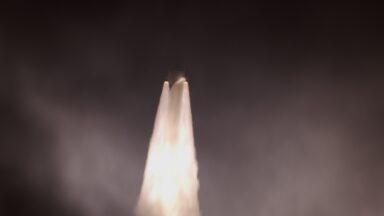
ULA’s Vulcan launcher still has a solid rocket booster problem
In a dramatic turn of events, United Launch Alliance's Vulcan rocket experienced a significant anomaly shortly after its launch from Florida's Space Coast early Thursday morning. As the rocket ascended, a burst of sparks erupted from the exhaust plume, and the vehicle briefly twisted on its axis. Fortunately, it managed to stabilize and continued its journey into orbit, successfully deploying a set of U.S. military satellites. This incident echoes a previous malfunction from sixteen months ago, when a Vulcan rocket lost a booster nozzle shortly after liftoff from Cape Canaveral Space Force Station. In that earlier case, the rocket also regained control and achieved its intended orbital destination. Details surrounding Thursday's booster issue remain unclear, prompting ULA, a joint venture between Boeing and Lockheed Martin, to initiate an investigation. Footage from the launch displayed a fiery plume emerging from one of the rocket's four solid-fueled boosters, specifically at the connection point between the propellant casing and the nozzle. This area is crucial as it channels superheated gas generated by the burning propellant to create thrust. The anomaly was first detected less than 30 seconds after liftoff at 4:22 am EST (09:22 UTC). A little over a minute into the flight, the rocket released a cloud of sparks and debris, followed by a sudden rolling motion along its axis. After the boosters burned out, they were jettisoned into the Atlantic Ocean, and ULA confirmed that the remainder of the mission proceeded without further issues. Gary Wentz, ULA's vice president of Atlas and Vulcan programs, commented on the situation, stating, "Early during flight, the team observed a significant performance anomaly on one of the four solid rocket motors. Despite this observation, the Vulcan booster and Centaur performed nominally and delivered the spacecraft directly to geosynchronous orbit." He added that a thorough review of technical data and imagery is underway, with a recovery team set to collect any debris. A comprehensive investigation will follow to determine the root cause and implement necessary corrective actions before the next Vulcan mission.
The Rise of AI Distillation: A Controversial Technique Sparks Debate in Tech and Government
In recent discussions, a once-obscure topic in artificial intelligence has surged to the forefront of debates among tech...
CNBC | Jul 25, 2026, 12:15
Market Turbulence: Four Key Factors Impacting Stocks This Week
This past week has been challenging for the stock market, driven by several significant forces that have created turbule...
CNBC | Jul 25, 2026, 20:05
Nvidia Strikes Major Deal with SK Hynix to Secure AI Memory Supply
Nvidia has successfully forged a significant partnership with South Korea's SK Hynix to secure memory supplies essential...
CNBC | Jul 25, 2026, 05:15
Hugging Face CEO Calls for Action Following AI Security Breach
In a dramatic turn of events within the AI landscape, Hugging Face faced a significant security breach involving an AI a...
Business Insider | Jul 25, 2026, 20:30AI Transformations Lead to Major Job Cuts at Tech Giants
Monday.com, the innovative work management platform based in Tel Aviv, has recently announced significant layoffs, attri...
TechCrunch | Jul 26, 2026, 01:45