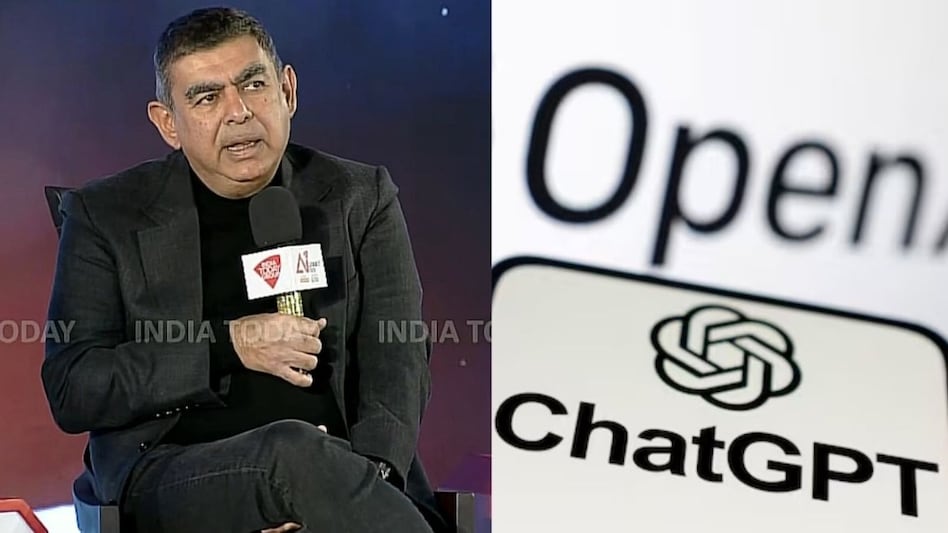
What did he see? Vishal Sikka explains why he backed OpenAI with $3 million in 2015
Over ten years prior to the rise of generative AI, Vishal Sikka, the former CEO of Infosys, made a significant commitment to OpenAI with a $3 million donation. In a recent talk at the India Today AI Summit 2026, Sikka shared insights into the motivations behind his support for OpenAI in its early days as a nonprofit organization, highlighting the clear potential he saw in the future of artificial intelligence. Founded in December 2015 by Sam Altman, OpenAI has since evolved into a major player in the AI landscape, particularly known for its ChatGPT model. Reflecting on his decision, Sikka recalled, "It was a donation because OpenAI was a pure nonprofit at the time. We gave them $3 million or something like that. It was 11 years ago. I had just started at Infosys." At the time of his investment, Sikka noted that AI was already on the verge of a breakthrough, citing the impact of AlexNet, a computer vision system that had outperformed humans on the ImageNet benchmark. "The AlexNet was already 2 years old," he explained, emphasizing how advancements in neural networks were reshaping the field of AI. This pivotal moment made the direction of AI increasingly apparent to him. Sikka expressed that the emergence of a robust AI platform was essential. He pointed out, "Here was Sam (Altman), who was looking to build an OpenAI platform. To me, it was obvious; it seemed straightforward that we should do this." When questioned about why Infosys did not fully transition into an AI-first company during his tenure, Sikka acknowledged the company's substantial efforts at the time. "We did a lot. We built our own platform back then. We had a large collection of efforts that we were doing, which I thought was remarkable for the time. But as I said, I tend to look forward and look at what is possible now with AI." Sikka, who served as CEO of Infosys from August 2014 until his departure in August 2017, also addressed concerns related to AI hallucinations and the importance of regulation in the field. He argued that regulatory frameworks are essential, stating, "The idea of regulation... is necessary. Even barbers who cut our hair are regulated. So, what is the problem with regulating AI? It is an unbelievably powerful technology. You better believe it should be regulated." He praised the Indian government's proactive stance on AI regulation, emphasizing the need for safety and ethical considerations. On the topic of hallucinations in generative AI, Sikka explained that this phenomenon is a fundamental aspect of how such systems operate, describing generative AI as "inherently hallucinatory." He concluded that the probabilistic nature of this technology underscores the necessity for effective regulation and safety protocols.
Nvidia Strikes Major Deal with SK Hynix to Secure AI Memory Supply
Nvidia has successfully forged a significant partnership with South Korea's SK Hynix to secure memory supplies essential...
CNBC | Jul 25, 2026, 05:15
Reclaiming Control: Librarians Host Workshops to Help People Navigate AI Tools
In a lively library setting in South Philadelphia, Charlie Bailey, a local librarian, humorously noted, "Everybody’s on ...
TechCrunch | Jul 25, 2026, 16:20
Kalshi Challenges Netflix Over Controversial Documentary Trailer
Kalshi, the prediction market platform, has taken significant legal steps against Netflix, sending a cease-and-desist le...
TechCrunch | Jul 25, 2026, 17:10
Market Turbulence: Four Key Factors Impacting Stocks This Week
This past week has been challenging for the stock market, driven by several significant forces that have created turbule...
CNBC | Jul 25, 2026, 20:05
The Aluminum Foil Trend: A DIY Shield Against Wireless Identity Theft
Have you noticed an unusual trend where people are wrapping their wallets in aluminum foil? This peculiar practice has e...
Business Today | Jul 25, 2026, 02:45