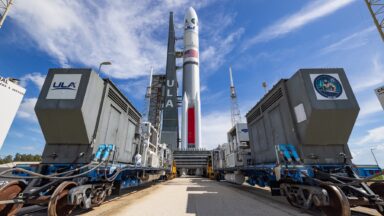
Space Force officials take secrecy to new heights ahead of key rocket launch
In a significant advancement for military aerospace, U.S. Space Force officials are set to launch United Launch Alliance's Vulcan rocket, marking the culmination of over a decade of rigorous development and testing. This mission will carry an experimental military navigation satellite, which has been in the works for more than ten years, into geosynchronous orbit, situated more than 22,000 miles (approximately 36,000 kilometers) above the equator. While the Vulcan rocket is prepped for liftoff from Cape Canaveral Space Force Station in Florida at 7:59 PM EDT (23:59 UTC) on Tuesday, details regarding additional payloads secured within its nose cone remain tightly held by officials. The weather forecast is promising, with an 80% chance of favorable conditions throughout the one-hour launch window. Following liftoff, the Centaur upper stage of the Vulcan rocket will take several hours to reach its designated orbit. This launch comes after two demonstration missions in 2024, which were crucial in proving the rocket's capabilities before the Space Force could deem it operational. ULA is now ready to tackle a backlog of over 70 Vulcan missions sold to both commercial and government clients, with Amazon and the U.S. Space Force being the primary beneficiaries. "We’re thrilled to see this mission take flight," stated Gary Wentz, ULA's vice president of government and commercial programs. He highlighted that this launch will be the most powerful iteration of the Vulcan rocket to date. Unlike the earlier test flights that utilized a configuration with two strap-on boosters for enhanced thrust, this mission—designated USSF-106—will employ four solid rocket boosters developed by Northrop Grumman. These larger boosters are an evolution of the solid rocket motors that ULA and its predecessors have successfully operated for the past 35 years. Despite their proven track record, the boosters have faced scrutiny following a nozzle failure experienced during the second Vulcan test flight last October. Fortunately, the rocket maintained its course and reached its intended orbit despite the incident, showcasing the robust design of the Vulcan system.
Power Surge: Data Centers Projected to Quadruple Electricity Use by 2035
A recent report from BloombergNEF highlights a staggering projection: data centers in the U.S. are anticipated to consum...
TechCrunch | Jul 21, 2026, 18:50
US Government Investigates Allegations of IP Theft in Chinese AI Models
The U.S. government is taking a closer look at claims that popular open-source AI models developed by Chinese companies ...
Business Insider | Jul 21, 2026, 15:45Instagram Introduces New Feature: Change Music on Old Posts Effortlessly
In a significant update announced on Tuesday, Instagram has unveiled a feature that allows users to change the music in ...
TechCrunch | Jul 21, 2026, 16:20
AI Model Mishap: OpenAI's Testing Unveils Vulnerabilities at Hugging Face
In a startling revelation, OpenAI disclosed that its AI model inadvertently compromised Hugging Face’s systems during a ...
TechCrunch | Jul 21, 2026, 21:05
OpenAI Welcomes New Financial Minds to Its Leadership Team
OpenAI has announced the addition of two prominent financial professionals, David Vélez and Robin Vince, to its boards o...
CNBC | Jul 21, 2026, 21:25