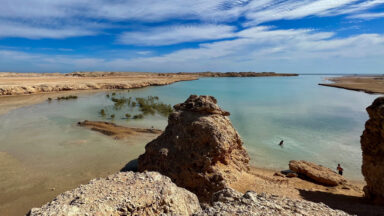
New report warns of critical climate risks in Arab region
A new report from the World Meteorological Organization (WMO) has issued a stark warning about the escalating climate risks facing around 480 million individuals in North Africa and the Arabian Peninsula. As global temperatures rise, these communities are increasingly subjected to extreme heat, drought, famine, and a heightened risk of mass displacement. The WMO’s latest State of the Climate report highlights a significant paradox: while the 22 countries in the Arab region produce approximately 25% of the world’s oil, they contribute only 5 to 7% of global greenhouse gas emissions. This positions the region as a critical player in the global fossil-fuel economy, yet also renders it one of the most vulnerable areas to climate change. WMO Secretary-General Celeste Saulo emphasized that prolonged periods of heat exceeding 50 degrees Celsius are pushing local populations to their limits. The region is marked by severe drought, yet also experiences devastating floods due to extreme rainfall, creating a precarious balance in one of the world’s most water-stressed environments. Geographically, the report covers a vast area from the Atlantic coast of West Africa to the Levantine mountains and the Arabian deserts, totaling over 5 million square miles—comparable to the continental U.S. west of the Mississippi River. Most inhabitants reside near river valleys or coastal cities, relying on fragile water resources, which makes them highly susceptible to even minor fluctuations in temperature and precipitation. Particularly alarming is the situation in Egypt’s Nile Delta, one of the most densely populated coastal regions globally. The delta is not only sinking but is also facing rapidly rising sea levels, putting around 40 million people and more than half of the nation’s agricultural output at significant risk. Recent findings from the Intergovernmental Panel on Climate Change warn that vast portions of the Nile Delta may soon experience chronic flooding, salinized soils, and permanent inundation under various future warming scenarios. Projections suggest that by 2050, a third of this vital farmland could be submerged, as even slight increases in sea level will push saltwater further inland.
Crisis Averted: Power Line Failure Highlights Urgent Need for Data Center Resilience
A power line failure near Washington, DC, recently showcased a significant challenge faced by the electrical grid due to...
TechCrunch | Jul 25, 2026, 13:50
Uber's Former CEO Makes Waves with New Ventures Amidst Tesla's Earnings Update
In the ever-evolving landscape of transportation, recent developments have come to the forefront, particularly surroundi...
TechCrunch | Jul 26, 2026, 16:25
Market Turbulence: Four Key Factors Impacting Stocks This Week
This past week has been challenging for the stock market, driven by several significant forces that have created turbule...
CNBC | Jul 25, 2026, 20:05
The Elusive Phineas Fisher: The Hacktivist Who Took Down Spyware Giants
In the realm of cybersecurity, few figures are as intriguing as Phineas Fisher, a hacker who has evaded capture for near...
TechCrunch | Jul 25, 2026, 21:00
AI Revolution: Sam Altman Declares We Are in the Singularity Era
OpenAI's CEO, Sam Altman, has boldly asserted that we have reached a pivotal moment in the evolution of artificial intel...
Business Insider | Jul 26, 2026, 18:10