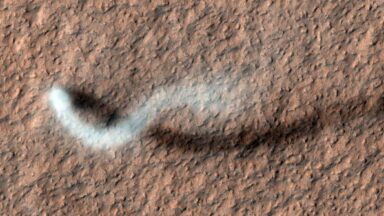
Tracking the winds that have turned Mars into a planet of dust
Mars, often characterized by its frigid temperatures and arid conditions, is also a planet dominated by dust. Intense winds sweep across its surface, lifting vast amounts of reddish dust into the atmosphere and creating swirling formations known as dust devils. These powerful gusts can even lead to massive dust storms that may last for days, obscuring the planet's surface. Researcher Valentin Bickel aimed to uncover the true intensity of these Martian winds. Utilizing data from the Mars camera CaSSIS (Color and Stereo Surface Imaging System), the ExoMars Trace Gas Orbiter, and the HRSC (High Resolution Stereo Camera) aboard the ESA's Mars Express, Bickel and his team employed deep learning techniques to analyze stereo images captured seconds apart from the same location. This innovative approach allowed them to track the movement of dust devils and assess the winds responsible for lifting the dust from the Martian surface. Bickel, affiliated with the Center for Space and Habitability at the University of Bern, discovered that the winds on Mars are even more vigorous than previously thought, transporting greater quantities of dust. "Our observations indicate that strong near-surface winds are prevalent on Mars and significantly contribute to atmospheric dust sourcing, enhancing the accuracy of models related to Mars' atmosphere, weather, and climate," the research team explained in a recently published study in Science Advances. On the Red Planet, the abundant dust not only affects surface conditions but also plays a critical role in atmospheric processes. Dust particles suspended in the air can lead to temperature fluctuations and alter atmospheric dynamics, potentially triggering enormous dust storms. Furthermore, dust that settles can reshape the landscape, as seen in the dark streaks on dry Martian slopes. While the question of whether life ever existed on Mars remains unanswered, the movement of dust may have implications for the planet's habitability by distributing nutrients and shielding potential life forms from harmful solar radiation.
Revolutionizing Furniture Delivery: AI Solutions to the Rescue
In a world where online shopping has become the norm, the expectation for seamless delivery services has never been high...
Business Insider | Jul 10, 2026, 16:35Disney+ Explores Free Streaming Options to Compete in the Market
Disney+ is exploring the option of introducing a free streaming tier, as revealed in a recent report by Business Insider...
TechCrunch | Jul 10, 2026, 16:35
China Advances in Reusable Rocket Technology, Challenging SpaceX's Dominance
China's state-owned space agency has made significant strides in reusable rocket technology, successfully launching a Lo...
TechCrunch | Jul 10, 2026, 17:15
The Shift in AI: From Size to Smart Solutions
The landscape of artificial intelligence is undergoing a significant transformation. For the past couple of years, the c...
CNBC | Jul 10, 2026, 21:35
Apple Files Lawsuit Against OpenAI Over Allegations of Trade Secret Misappropriation
In a dramatic turn of events, Apple has initiated legal action against OpenAI in a federal court located in Northern Cal...
CNBC | Jul 10, 2026, 20:45