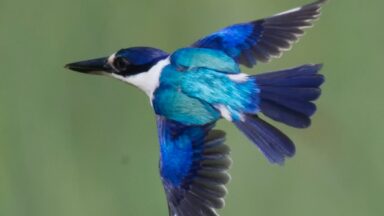
What the Chinese art of tian-tsui has to do with kingfishers
In the Qing dynasty, Chinese artisans masterfully enhanced decorative items by incorporating the stunning feathers of kingfishers, a technique known as tian-tsui. Recent research from Northwestern University’s Center for Scientific Studies in the Arts has shed light on this ancient art form, utilizing advanced high-energy x-ray imaging to explore the intricate nanoscale structure of these feathers. At the annual meeting of the American Association for the Advancement of Science, scientists revealed that nature itself serves as the ultimate nanofabricator. The vibrant iridescent hues seen in elements such as butterfly wings, soap bubbles, opals, and beetle shells arise not from pigments but from their structural composition—essentially, naturally occurring photonic crystals. For instance, the chitin scales found in insects are arranged in a manner similar to roof tiles, functioning as a diffraction grating. Unlike traditional diffraction gratings that emit the full spectrum of light like a prism, photonic crystals are designed to reflect specific wavelengths. In kingfisher feathers, the vivid colors are attributed to the microscopic ridges that line the keratin strands along the feather's central shaft. These photonic band-gap materials can be finely tuned to block certain light wavelengths while allowing others to pass through. By adjusting the structural dimensions, the crystals can be made sensitive to different wavelengths of light, making them invaluable in optical communications, filters, lasers, mirrors, and stealth technologies. The beauty of the kingfisher has long inspired poets and artists alike. Gerard Manley Hopkins celebrated their vibrant colors in his poem “As Kingfishers Catch Fire,” but the admiration for these birds began much earlier in Chinese culture. The practice of tian-tsui, or “dotting with kingfishers,” illustrates the high regard for these feathers, which were meticulously cut and affixed to gilt silver for use in fans, hairpins, screens, panels, and headdresses—carefully arranged to showcase their brilliant colors. However, the demand for kingfisher feathers led to significant declines in their populations, prompting conservation concerns and resulting in the last tian-tsui studio closing its doors in 1933. This fascinating intersection of art and science highlights not only the beauty of nature but also the implications of human impact on wildlife.
YouTube Tightens Rules to Combat Low-Quality AI Content
YouTube has recently updated its policies to tackle the rise of subpar content generated by artificial intelligence. The...
TechCrunch | Jul 20, 2026, 16:00
Boeing's Strategic Shift in Aircraft Development: Insights and Caution Ahead of Earnings
Boeing is making notable strides in its aircraft development strategy, embracing modern approaches that reflect changing...
CNBC | Jul 20, 2026, 16:25
Cybersecurity Alert: Millions of WordPress Sites at Risk from Exploited Vulnerabilities
Recent cybersecurity reports indicate that hackers are actively targeting websites that utilize outdated versions of the...
TechCrunch | Jul 20, 2026, 15:55
Flock Safety's CEO Takes the Stage at TechCrunch Disrupt to Address Surveillance and Privacy Challenges
The ongoing discussion regarding the balance between privacy and public safety has become increasingly critical in the a...
TechCrunch | Jul 20, 2026, 14:45
Airbnb and Anthropic Forge Ahead with Expansions in NYC Amid Business Concerns
Airbnb and the AI startup Anthropic are setting their sights on significant growth in New York City, with plans for new ...
Business Today | Jul 20, 2026, 14:05