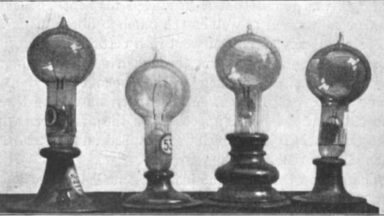
Did Edison accidentally make graphene in 1879?
Graphene, recognized as the world's thinnest material, consists of a single layer of carbon atoms arranged in a hexagonal pattern. This unique configuration endows graphene with remarkable characteristics that have substantial potential across various applications, including batteries, supercapacitors, antennas, water filtration systems, transistors, solar panels, and touchscreens. While the physicists who first successfully synthesized graphene in 2004 received the Nobel Prize in Physics in 2010, a recent study suggests that Thomas Edison might have inadvertently produced graphene during his early experiments with incandescent bulbs in the late 19th century. This intriguing possibility is detailed in a new paper published in the journal ACS Nano. Co-author James Tour, a chemist at Rice University, expressed excitement about the implications of Edison's work, stating, "Reproducing what Thomas Edison did with today's tools and knowledge is thrilling. His potential discovery of graphene raises fascinating questions about what other scientific insights could be uncovered by revisiting historical experiments. What inquiries might our scientific ancestors pose if they could collaborate with us in a modern laboratory?" Although Edison is often credited with inventing the incandescent lamp, various versions existed prior to his design. These earlier models suffered from short lifespans and required excessive electric currents, rendering them unsuitable for Edison's vision of widespread commercial use. He experimented with multiple filament materials, starting with carbonized cardboard and lampblack, both of which failed quickly. Subsequent attempts using different plant materials, such as hemp and palmetto, also proved unsuccessful. Ultimately, Edison found that carbonized bamboo provided the most effective filament, achieving lifespans exceeding 1200 hours when powered by a 110-volt source. Lucas Eddy, a graduate student working with Tour at Rice, was exploring methods to mass-produce graphene using simple and affordable equipment. He considered various approaches, including arc welding and natural occurrences like lightning strikes, but these were deemed impractical. Eddy concluded that Edison's light bulb would be an ideal candidate for producing graphene, as it could reach the necessary temperatures of 2000 degrees Celsius for flash Joule heating, a technique recognized as the most effective for generating turbostratic graphene.
Spotify's Daniel Ek Secures $700 Million for Revolutionary Health Startup Neko Health
Neko Health, the innovative body-scanning and health assessment firm co-founded by Spotify's Daniel Ek and Hjalmar Nilso...
TechCrunch | Jul 15, 2026, 20:05
OpenAI Ventures into Hardware with Innovative $230 Keyboard for Codex
OpenAI is stepping into the hardware arena with the unveiling of the Codex Micro, a $230 illuminated keyboard crafted to...
TechCrunch | Jul 15, 2026, 19:55
AWS Veteran Executive Steps Down After Nearly Two Decades
A key figure in Amazon Web Services (AWS) is set to leave the company after nearly 19 years of service. Dave Brown, who ...
CNBC | Jul 15, 2026, 18:35
SpaceX Stock Faces Challenges Ahead of Key Starship Launch
SpaceX's stock has dipped below its initial public offering (IPO) price of $135, as set by CEO Elon Musk. On Wednesday a...
TechCrunch | Jul 15, 2026, 18:15
Concerns Rise as New York Halts Data Center Construction Amid Political Tensions
A wave of anxiety is sweeping through the data center development sector following New York Governor Kathy Hochul's rece...
Business Insider | Jul 15, 2026, 18:50