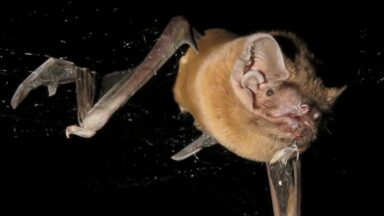
Tracking bats as they hunt birds in the skies above Europe
In a groundbreaking study, researchers have uncovered the hunting techniques of three bat species known to prey on birds. The evidence for this behavior emerged from findings of feathers and avian remains in bat feces. Yet, the intricacies of how these bats, significantly larger and faster than their usual insect prey, hunt their feathered targets remained a mystery. To unravel this, biologist Elena Tena from the Doñana Biological Station in Seville, Spain, and her team attached ultra-lightweight sensors to the Nyctalus lasiopterus, commonly referred to as greater noctule bats. These bats, boasting a wingspan of roughly 45 centimeters and a weight range of 40 to 60 grams, are the largest species among those known to hunt birds. The challenge, however, was to find sensors light enough that they wouldn't hinder the bats' ability to fly. Conventional cameras, which typically would be used for such studies, were deemed impractical due to their weight, especially since bats are nocturnal hunters. "We needed our sensors to weigh less than 10 percent of the bat's weight, around four to six grams," Tena noted. Over the past decade, the research team explored various methods, including ground observations and military-grade radar, but capturing the bats in action proved elusive. Fortunately, advancements in technology and sensor miniaturization finally aligned with Tena's requirements. Over two years, the team successfully fitted 14 greater noctule bats with tags that weighed about four grams each. These tags were capable of running for several hours while recording sound, altitude, and acceleration, providing invaluable insights into bat behavior in the nocturnal sky. The data captured ambient sounds and the high-frequency echolocation calls used by bats, allowing researchers to map their dynamic movements, including sharp turns and dives as they hunted. This innovative research not only sheds light on the predatory behaviors of these unique bats but also contributes to our understanding of their ecological role in the environment.
The Aluminum Foil Trend: A DIY Shield Against Wireless Identity Theft
Have you noticed an unusual trend where people are wrapping their wallets in aluminum foil? This peculiar practice has e...
Business Today | Jul 25, 2026, 02:45
Nvidia Strikes Major Deal with SK Hynix to Secure AI Memory Supply
Nvidia has successfully forged a significant partnership with South Korea's SK Hynix to secure memory supplies essential...
CNBC | Jul 25, 2026, 05:15
Prentis: Ambitious New AI Lab Eyes $100 Million Funding with Innovative Automation Goals
Prentis, a cutting-edge AI research laboratory co-founded by Ritankar Das, Reid Hoffman, and Marc Pincus, is currently i...
TechCrunch | Jul 24, 2026, 22:45
OpenAI's Micro Keypad: A Novelty for Coders or Just a Confounding Gadget?
Last week, OpenAI made its debut in the hardware landscape with the launch of Micro, a stylish keypad designed to integr...
TechCrunch | Jul 25, 2026, 24:40
Waymo to Launch Standalone App, Ending Exclusivity with Uber in Major Cities
For the past three years, Uber and Waymo, the autonomous vehicle division of Alphabet, have collaborated to provide driv...
CNBC | Jul 24, 2026, 21:55