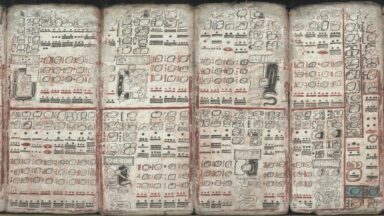
Study: How the Maya created such accurate eclipse tables
Eclipses held a significant place in Maya culture, highlighting their dedication to precise calendar systems that facilitated celestial forecasting. Central to this understanding is the Dresden Codex, one of the rare surviving Maya manuscripts, which includes an intricate table of eclipses. Recent research published in the journal Science Advances has revealed that this eclipse table was adapted from earlier lunar month tables, challenging previous assumptions of its exclusive purpose for eclipse forecasting. The researchers uncovered the methods employed by the Maya to ensure the longevity and accuracy of their astronomical records. The Maya utilized three main calendars: the Long Count, which tracked days; the Tzolk’in, a 260-day astrological calendar; and the Haab’, a 365-day year. While scholars have pondered the profound impact of solar and lunar eclipses on Maya society, much remains unknown about their extensive astronomical expertise, largely due to the destruction of most Maya texts by Spanish colonizers and missionaries. Only four hieroglyphic codices have survived the ravages of time: the Dresden Codex, the Madrid Codex, the Paris Codex, and the Grolier Codex. The Dresden Codex, dating back to the 11th or 12th century and believed to have originated near Chichen Itza, is notable for its accordion-style design, extending to an impressive 12 feet when fully unfurled. Deciphered in the early 20th century, this codex not only chronicles local history but also features detailed astronomical tables for lunar and Venus cycles. In their study, co-authors John Justeson from the University at Albany and Justin Lowry of SUNY-Plattsburgh focused on specific pages of the Dresden Codex that feature comprehensive eclipse tables, covering all solar and most lunar eclipses. Remarkably, these tables are accurate enough to extend from the 8th century to the 18th century. The Madrid Codex, while also containing an eclipse almanac, primarily discusses the relationship between eclipses and agricultural cycles.
Revolutionizing Fashion: Daydream's AI Agent Takes Personal Styling to New Heights
Can artificial intelligence truly revolutionize personal styling? Daydream, a startup founded by e-commerce expert Julie...
TechCrunch | Nov 17, 2026, 16:45
Charles Schwab Faces Website Outage Amid User Complaints
Charles Schwab, the prominent brokerage firm, experienced significant website issues this week, impacting numerous users...
Business Insider | Nov 17, 2026, 15:40Voyage Labs Secures $12 Million to Revolutionize Travel Planning with AI
In an exciting development for the travel industry, Voyage Labs has announced the successful raising of $12 million in s...
TechCrunch | Nov 17, 2026, 15:15
Instagram Launches Innovative Tool to Safeguard Creators’ Content from Unauthorized Use
In a bold move to empower content creators, Instagram has unveiled a new tool designed to safeguard their original video...
TechCrunch | Nov 17, 2026, 15:10
Jensen Huang Open to Returning as Nvidia CEO Amid Growing Support
In a surprising turn of events, Jensen Huang, the former CEO of Nvidia, expressed his willingness to return to the helm ...
Business Today | Nov 17, 2026, 16:35