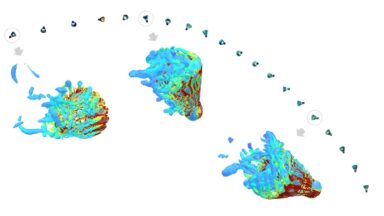
Physics of badminton’s new killer spin serve
Professional badminton players are always on the lookout for techniques that can give them a competitive edge. Recently, the spin serve has emerged as a groundbreaking method, where players apply a pre-spin to the shuttlecock just before making contact. This serve has proven to be so effective that some have labeled it "impossible to return." In response to growing concerns about the potential unfair advantages the spin serve could provide, the Badminton World Federation (BWF) decided to ban it in 2023, with the prohibition remaining in place at least until the conclusion of the 2024 Paralympic Games in Paris. The BWF's decision was not intended to stifle innovation but rather to address the worries of players regarding the technique's impact on competition. They felt that international tournaments should not serve as testing grounds for a technique reminiscent of the previously banned "Sidek serve." Earlier this year, the BWF made the ban on the spin serve permanent. In an intriguing scientific development, Chinese researchers have recently examined the intricate physics underlying the spin serve. Their findings were published in the journal Physics of Fluids. The unique design of shuttlecocks, with their open conical shape and sixteen overlapping feathers atop a cork base, contributes significantly to their aerodynamics. While casual players might opt for synthetic nylon birdies, serious competitors prefer feathered ones due to their superior performance. The overlapping feathers create substantial drag, causing the shuttlecock to decelerate quickly and resulting in a steeper descent during its flight. This increased drag necessitates considerable force from players to propel the shuttlecock the full length of the court. Remarkably, shuttlecocks can reach speeds exceeding 300 mph. Additionally, the natural spin imparted by the feathers affects how different strokes perform. For example, slicing from right to left can enhance the effectiveness of a tumbling net shot. The cork base of the shuttlecock ensures aerodynamic stability, allowing the birdie to orient itself cork-first during flight and maintain this position throughout its trajectory. A 2015 study delved into the physics of this distinctive orientation by capturing high-speed video footage and conducting experiments in a water tank to analyze how the shuttlecock’s geometry influences its behavior. The study confirmed that feathered shuttlecocks outperform their synthetic counterparts, as they deform more upon impact, resulting in a more favorable trajectory.
Major $1.5 Billion Copyright Settlement Approved for Anthropic
Anthropic is set to disburse payments to a collective of authors and publishers following a significant $1.5 billion set...
TechCrunch | Jul 21, 2026, 24:40
Google's Ambitious AI Chip: Frozen V2 Set to Revolutionize Gemini Performance
Alphabet, the parent company of Google, is reportedly in the process of creating a cutting-edge artificial intelligence ...
Business Today | Jul 21, 2026, 05:55
Kimi K3 Ignites Debate on China's AI Landscape Amidst Global Competition
The recent unveiling of Moonshot AI's Kimi K3 model has set the Chinese internet abuzz with conversations and comparison...
Business Insider | Jul 21, 2026, 09:30Navigating Market Turbulence: Cramer Urges Caution in Tech Investments
In a recent discussion, CNBC's Jim Cramer expressed concerns about the current state of the artificial intelligence mark...
CNBC | Jul 20, 2026, 22:35
Exploring the Rise of the Clipping Economy and Its Impact on Gen Z Wealth
An emerging trend known as the 'clipping economy' is paving the way for a new generation of millionaires, particularly a...
CNN | Jul 21, 2026, 09:20