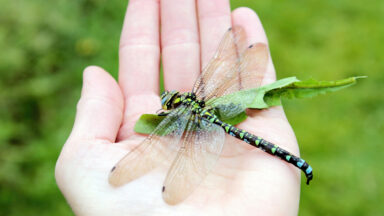
Leading explanation for ancient giant, flying insects gets squashed
Three hundred million years ago, the skies of the late Palaeozoic era were dominated by colossal insects like Meganeuropsis permiana, a formidable predator akin to today's dragonflies, boasting a wingspan exceeding 70 centimeters and weighing around 100 grams. For decades, scientists pondered why such massive insects no longer roam the Earth. A popular theory known as the "oxygen constraint hypothesis" suggested that these enormous creatures required highly oxygenated air to thrive, due to the inefficiencies of their respiratory systems compared to mammals and birds. The prevailing belief was that as atmospheric oxygen levels decreased, the survival of giant insects became untenable. However, recent insights challenge this long-held notion. Edward Snelling, a veterinary science professor at the University of Pretoria, argues that the explanation is overly simplistic and fundamentally flawed. Unlike mammals, insects do not possess centralized lungs or a closed circulatory system; instead, they breathe through a network of tubes called the tracheal system. Air enters their bodies through small openings on their exoskeleton known as spiracles, then travels through progressively smaller tubes called tracheae, branching into even tinier tracheoles that reach deep into their tissues. Insects have the ability to actively pump air into these larger tracheae by flexing their bodies, but the final delivery of oxygen to tissues depends on passive diffusion, which is inherently slow. The oxygen constraint hypothesis posited that the larger an insect grows, the more challenging it becomes for oxygen to reach its deepest tissues due to the increased distance. According to Snelling, this presents a significant issue: as insects increase in size, the demand for oxygen in their muscles escalates. To meet this demand, larger insects would require either significantly larger or more numerous tracheoles, suggesting a critical structural limit. If an insect grows too large, the necessary breathing tubes would occupy too much space, impeding their muscle function and ultimately compromising their flight capabilities.
SpaceX Successfully Tests Starship Rocket, Launching New Era of Space Exploration
On Friday evening, SpaceX executed a significant milestone by launching its colossal Starship rocket from its facility i...
CNBC | Jul 25, 2026, 24:10
OpenAI's Micro Keypad: A Novelty for Coders or Just a Confounding Gadget?
Last week, OpenAI made its debut in the hardware landscape with the launch of Micro, a stylish keypad designed to integr...
TechCrunch | Jul 25, 2026, 24:40
Hugging Face CEO Calls for Action Following AI Security Breach
In a dramatic turn of events within the AI landscape, Hugging Face faced a significant security breach involving an AI a...
Business Insider | Jul 25, 2026, 20:30Vision Breakthrough: US Startup Launches Groundbreaking Retina Chip in Europe
Science Corp is poised to introduce a revolutionary retina chip in Europe, designed to restore partial vision for indivi...
Business Today | Jul 25, 2026, 01:00
Unleashing the Power of AI: The 5 Smartphones Redefining Mobile Photography
Artificial Intelligence (AI) is transforming our daily experiences, permeating various aspects of technology, including ...
Business Today | Jul 26, 2026, 07:05