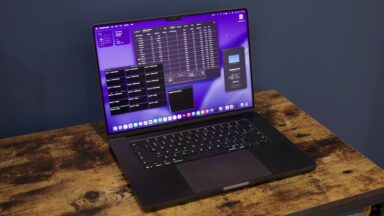
Testing Apple’s 2026 16-inch MacBook Pro, M5 Max, and its new “performance” cores
Apple has made significant strides with its latest M5 Pro and M5 Max chips, introducing substantial changes to the architecture of its high-end laptops and desktops. Unlike previous models, these new processors do not feature a single monolithic design that combines all CPU and GPU cores on one chip. Instead, Apple has adopted an innovative 'Fusion Architecture' that separates the CPU and GPU cores into distinct silicon dies, which are then combined into one cohesive unit. Both the M5 Pro and M5 Max utilize an 18-core CPU die, but they differ in their GPU configurations: the M5 Pro boasts a 20-core GPU, while the M5 Max escalates performance with a robust 40-core GPU. This separation not only enhances processing capabilities but also optimizes memory bandwidth, as the memory controller is integrated within the GPU die, allowing the M5 Max to support larger memory configurations than its Pro counterpart. In a notable shift, Apple has also redefined its terminology regarding CPU cores. The M5 series moves away from the traditional 'efficiency' cores, now branding all large cores as 'super' cores, a change that will be evident in the upcoming macOS 26.3.1. While the standard M5 retains its smaller efficiency cores, the M5 Pro and M5 Max introduce a third type of core, labeled as 'performance' cores, which are not to be confused with the rebranded efficiency cores. For users, the M5 Pro and M5 Max will feel like expected upgrades from the previous generation, consistent with Apple's pattern of iterative improvements in Silicon processors. However, for tech enthusiasts, delving into the specifics of the M5 Max reveals a deeper understanding of its performance capabilities and clarifies the distinction between the newly named cores and the actual enhancements made in this generation.
Warner Bros. Takes Legal Action Against Amazon Over Executive Poaching Allegations
Warner Bros. Discovery has initiated legal proceedings against Amazon, accusing the tech giant of unlawful interference ...
TechCrunch | Jul 25, 2026, 21:25
The Future of Work: Executives Weigh In on AI's Impact on Gen Z Careers
As generative artificial intelligence continues to rise, uncertainty looms for the incoming Gen Z workforce. Leaders fro...
Business Insider | Jul 26, 2026, 10:15The Shift in Human Cognition: Embracing AI as a Collaborative Tool
As technology continues to evolve, a notable shift is occurring in the relationship between humans and artificial intell...
Business Insider | Jul 25, 2026, 09:50Crisis Averted: Power Line Failure Highlights Urgent Need for Data Center Resilience
A power line failure near Washington, DC, recently showcased a significant challenge faced by the electrical grid due to...
TechCrunch | Jul 25, 2026, 13:50
Hugging Face CEO Calls for Action Following AI Security Breach
In a dramatic turn of events within the AI landscape, Hugging Face faced a significant security breach involving an AI a...
Business Insider | Jul 25, 2026, 20:30