Can AI solve physics' biggest mystery - quantum gravity? Physicist Ashoke Sen says this
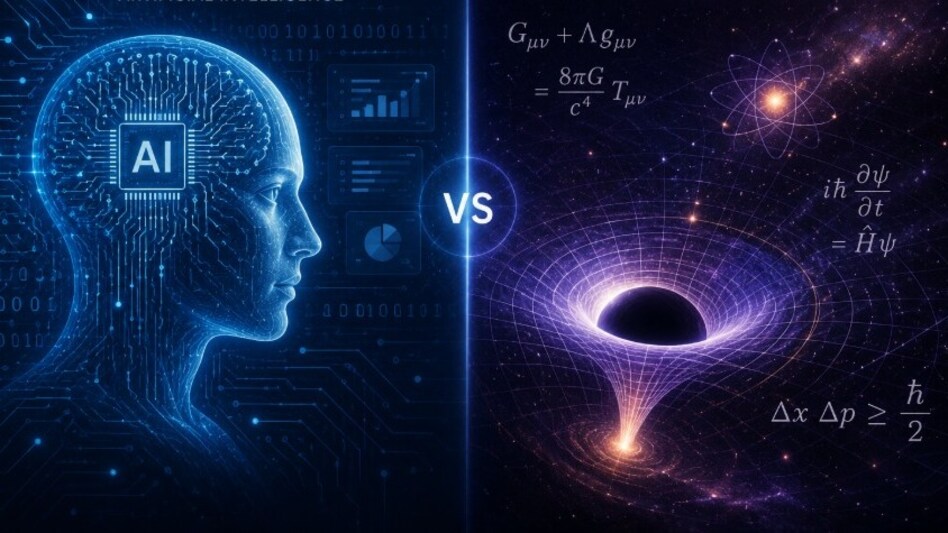
The realm of scientific research is undergoing a profound transformation, fueled by the rapid advancements in artificial intelligence (AI). This evolution raises an intriguing question: could AI eventually unravel some of the most profound mysteries in physics? Professor Ashoke Sen, a prominent theoretical physicist from India, views this potential not as a threat but as an opportunity. He suggests that if AI were to crack the enigma of quantum gravity—the long-standing puzzle of merging quantum mechanics with Einstein's gravitational theory—it would be a monumental achievement worth celebrating. In a recent interview with Rocket Media, Sen shared his insights, highlighting that while AI has become an invaluable tool in his research, it is not yet a substitute for human scientists. "If AI can solve the problem of quantum gravity, I'll be very happy," he stated, emphasizing that until that day arrives, he still has plenty of work ahead of him. Sen frequently employs AI to gather data and tackle scientific challenges. However, he cautioned against blind dependence on these technologies. "I use AI quite often. Sometimes it's beneficial and yields valuable insights, but at other times, it can produce complete nonsense," he remarked. He believes that early-career researchers should leverage AI as a complementary tool while recognizing the irreplaceable role of human judgment in scientific exploration. The quest to understand quantum gravity remains one of the most significant challenges in contemporary physics. Quantum mechanics adeptly describes particle behavior at minute scales, while Einstein's general theory of relativity accurately characterizes gravity on a cosmic scale. Yet, these theories clash when applied to extreme scenarios, such as the interiors of black holes or the universe's earliest moments. For decades, physicists have sought a unified framework to reconcile these theories, with superstring theory emerging as a prominent candidate—a field where Sen has made substantial contributions. Despite the rise of advanced AI models, Sen asserts that they are not yet capable of independent breakthroughs in fundamental physics. Instead, he encourages researchers to view AI as an assistant to human intellect rather than a replacement. Sen emphasized the importance of human involvement in scientific inquiry. "My experience shows that AI still cannot replicate what humans do. It can generate results, but it requires human oversight," he explained. He acknowledged that while AI technology may evolve, the need for human intellect and insight in research will persist for the foreseeable future. In urging young scientists to embrace AI, Sen reminded them of the perseverance required in scientific research. "Make use of AI," he advised, while also noting that many aspects of research demand years of dedication—qualities that technology cannot replicate. He painted a realistic picture of the research process, stating, "Probably 80% of the time you're completely stuck. Nothing is happening. Only 20% of the time do you actually make progress." This perspective underscores the necessity of patience and resilience in the pursuit of scientific discovery.
Jensen Huang's Remarkable Comeback: A Look at Corporate Resurgences
Jensen Huang has made headlines with his return to the helm of Nvidia on November 23, merely 11 days after stepping down...
Business Today | Nov 24, 2026, 20:15
Instagram Integrates AI Assistant Muse for Enhanced User Experience
In a significant move, Meta has announced the integration of its AI assistant, Muse, directly into Instagram's direct me...
TechCrunch | Nov 24, 2026, 17:25
Mathematicians React to Controversial Joke Over Lengthy Proof of Riemann Hypothesis
Tensions are rising in the mathematical community following a controversial comment made by Levent Alpöge, a researcher ...
Business Insider | Nov 24, 2026, 17:30Nvidia's Board Shake-Up: The High-Stakes Return of Jensen Huang
Nvidia's CEO Jensen Huang has received unwavering support from longtime board members Tench Coxe, Mark Stevens, and Harv...
CNN | Nov 24, 2026, 23:00
Jensen Huang Shares Personal Journey in First All-Hands Meeting Post-Reinstatement
In a pivotal moment for Nvidia, CEO Jensen Huang addressed employees on Tuesday during his first companywide meeting sin...
Business Insider | Nov 24, 2026, 19:55