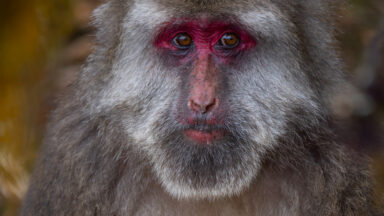
Macaque facial gestures are more than just a reflex, study finds
Recent breakthroughs in brain-computer interface technology have enabled researchers to more accurately interpret speech from neural signals in humans. However, language is merely one aspect of our communication toolkit. Geena Ianni, a neuroscientist at the University of Pennsylvania, emphasizes the importance of non-verbal cues: "When my young nephew asks for ice cream before dinner and I respond with a 'no,' the intent is significantly influenced by whether my expression is a smirk or a stern frown." Ianni envisions a future where neural prostheses designed for individuals with strokes or paralysis will be capable of interpreting facial gestures from brain signals, much like they process spoken language. To lay the groundwork for such advancements, Ianni and her research team conducted a study aimed at understanding the neural circuitry involved in facial expressions. "While recent neuroscience has made strides in understanding how the brain perceives facial expressions, our knowledge of how these expressions are generated remains limited," she notes. Their findings challenge long-held beliefs in the field, revealing that much of what was previously assumed about facial gestures is incorrect. Historically, scientists believed that facial gestures in primates were the result of distinct divisions of labor within the brain. Ianni explains, "Case studies involving patients with brain lesions indicated that specific brain regions were responsible for certain emotional expressions, while others controlled voluntary movements such as speech." To bridge this knowledge gap, Ianni and her team conducted an experiment using macaques—social primates with facial musculature closely resembling that of humans. The research involved placing the macaques in an fMRI scanner to observe their brain activity while capturing their facial movements with a high-resolution camera. The researchers exposed the macaques to various stimuli, including videos of other macaques making facial expressions, interactive avatars, and live peers. "This approach elicited socially significant facial expressions that are integral to the subjects' natural behavior," Ianni adds.
OpenAI's Micro Keypad: A Novelty for Coders or Just a Confounding Gadget?
Last week, OpenAI made its debut in the hardware landscape with the launch of Micro, a stylish keypad designed to integr...
TechCrunch | Jul 25, 2026, 24:40
Finland Unveils World's Largest Sand Battery to Tackle Renewable Energy Challenges
In a groundbreaking move to address the critical issue of renewable energy intermittency, a small town in southern Finla...
CNBC | Jul 25, 2026, 05:35
Waymo Considers Parting Ways with Uber Amid Rising Tensions
Waymo is reportedly exploring options to exit its partnership with Uber, which has allowed the Alphabet-owned firm to de...
TechCrunch | Jul 24, 2026, 21:00
Rising Concerns in Bond Market as AI Investments Surge
Investors are growing increasingly uneasy about the substantial capital required to realize the ambitions of artificial ...
CNBC | Jul 24, 2026, 20:15
Volkswagen Engineers Indicted for Insider Trading Linked to Rivian Partnership
In a significant legal development, the U.S. Department of Justice has brought securities fraud charges against two engi...
TechCrunch | Jul 24, 2026, 20:30