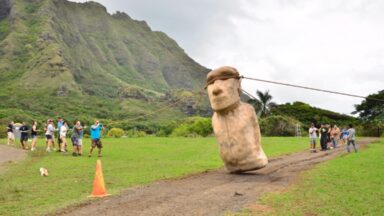
How Easter Island’s giant statues “walked” to their final platforms
Easter Island, renowned for its impressive moai statues, has intrigued researchers for centuries. These monumental figures, sculpted around 800 years ago, were originally placed on stone platforms called ahu. The challenge of understanding their cultural importance, as well as the methods used by a Stone Age society to carve and transport these colossal statues, some weighing up to 92 tons, has captivated scholars. One prominent theory, proposed by archaeologist Carl Lipo from Binghamton University, suggests that the moai were moved while standing upright. According to this hypothesis, workers employed ropes to 'walk' the statues into position on their platforms. This idea is supported by the oral histories of the Rapa Nui people, which include narratives about the moai's journey from the quarry, including a song that recounts an ancestor who made the statues walk. Though initial field tests hinted at the feasibility of this approach, it sparked considerable debate within the academic community. To address these concerns, Lipo has collaborated on a new study published in the Journal of Archaeological Science, which presents new experimental evidence and utilizes 3D modeling to explore the physics behind the moai's movement. When the first Europeans arrived in the 17th century, they found only a few thousand inhabitants on the island, which is merely 14 by 7 miles in size and located far from any other land. This led to the assumption that the island's past must have hosted tens of thousands of residents to account for the numerous moai. However, Lipo proposed that fewer workers could achieve this monumental task. In 2012, he and colleague Terry Hunt from the University of Arizona demonstrated that a 10-foot, 5-ton moai could be moved several hundred yards with just 18 people and three ropes by utilizing a rocking motion. In a subsequent study in 2018, Lipo introduced an intriguing concept regarding the placement of red hats atop some moai, which can weigh up to 13 tons. He suggested that these hats were rolled up ramps using ropes. Moreover, findings from Lipo’s team, based on quantitative spatial modeling, indicated that the locations chosen for the moai were likely influenced by the availability of fresh water sources, as revealed in a 2019 paper published in PLOS One.
Amazon Addresses AWS Billing Glitch Affecting Customers
On Friday, numerous users of Amazon's cloud services were taken aback by unexpected billing estimates indicating they ow...
TechCrunch | Jul 17, 2026, 15:50
Valar Atomics Eyes $6 Billion Valuation with New Funding Talks for Modular Nuclear Reactors
Valar Atomics, an innovative startup focused on developing small modular nuclear reactors (SMRs), is currently negotiati...
TechCrunch | Jul 17, 2026, 19:45
Why This Chipmaker Still Has Strong Potential After Recent Market Decline
Despite experiencing a significant 30% drop in stock value this month, analysts continue to express confidence in this s...
CNBC | Jul 17, 2026, 16:05
Final Call for Australian Startups: Seize Your Chance at Stripe x Startup Battlefield
Time is running out for aspiring Australian entrepreneurs! In just 48 hours, the opportunity to showcase your startup at...
TechCrunch | Jul 17, 2026, 23:25
Agility Robotics Expands Operations Near Tesla, Aiming for Humanoid Robot Leadership
Agility Robotics is set to launch a substantial 60,000-square-foot facility in Fremont, California, strategically locate...
TechCrunch | Jul 17, 2026, 20:35