Switching water sources improved hygiene of Pompeii’s public baths
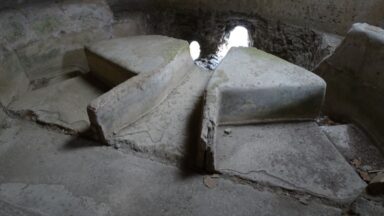
The catastrophic eruption of Mount Vesuvius in 79 CE unleashed thermal energy estimated to be 100,000 times stronger than the atomic bombs dropped on Hiroshima and Nagasaki, engulfing Pompeii in molten rock, pumice, and scorching ash. Among the remnants preserved from this disaster are the public baths, aqueducts, and water towers that provide a glimpse into the ancient city's infrastructure. A recent study published in the *Proceedings of the National Academy of Sciences* delves into the calcium carbonate deposits found in these structures, shedding light on the evolution of Pompeii’s water supply. Established in the sixth century BCE, Pompeii initially relied on rainwater collected in cisterns and wells. Public baths utilized mechanical systems to draw water from wells that reached depths of up to 40 meters. As Pompeii expanded, so did its water supply system, most significantly with the construction of an aqueduct between 27 BCE and 14 CE. The researchers examined the calcium carbonate deposits from well shafts, baths, and the aqueduct itself. These deposits exhibit varying chemical compositions and crystal structures, which can provide insights into historical temperature fluctuations and changes in water chemistry over time. This analysis aims to reconstruct the operational history of public baths, highlighting their maintenance and the adaptations made throughout different eras. The study focused on four key periods: the second century to 80 BCE; the time after 80 BCE when Pompeii was designated a Roman colony; the era of Emperor Augustus from 31 BCE to 14 CE; and the aftermath of the significant earthquake that struck the city in 62 CE. Fieldwork conducted in 2016 and 2017 enabled the collection of calcium carbonate samples, alongside present-day groundwater and springs thought to have fed the aqueduct. However, the researchers noted that these properties might have undergone considerable changes, especially following the devastating eruption in 79 CE.
Kalshi Challenges Netflix Over Controversial Documentary Trailer
Kalshi, the prediction market platform, has taken significant legal steps against Netflix, sending a cease-and-desist le...
TechCrunch | Jul 25, 2026, 17:10
AI Transformations Lead to Major Job Cuts at Tech Giants
Monday.com, the innovative work management platform based in Tel Aviv, has recently announced significant layoffs, attri...
TechCrunch | Jul 26, 2026, 01:45
Market Turbulence: Four Key Factors Impacting Stocks This Week
This past week has been challenging for the stock market, driven by several significant forces that have created turbule...
CNBC | Jul 25, 2026, 20:05
Finland Unveils World's Largest Sand Battery to Tackle Renewable Energy Challenges
In a groundbreaking move to address the critical issue of renewable energy intermittency, a small town in southern Finla...
CNBC | Jul 25, 2026, 05:35
Shifting Focus: The Cost-Effectiveness of AI Models Takes Center Stage
In recent years, the AI sector has been intensely focused on identifying the most advanced models. While this pursuit re...
Business Insider | Jul 25, 2026, 13:10