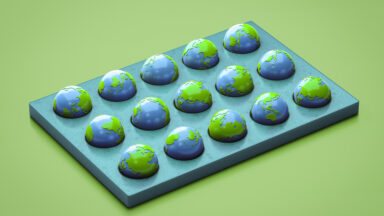
Earth models can predict the planet’s future but not their own
In the 1960s, meteorologist Edward Lorenz was pioneering weather simulations on early computer systems when he discovered that even minor rounding errors could lead to vastly different weather forecasts. This phenomenon, which he famously termed the butterfly effect, illustrates how small variations in initial conditions—like a butterfly flapping its wings in Nepal—can result in significant consequences, such as rainfall in New York City. Today, a more profound understanding of these initial conditions, coupled with insights into how biological systems interact with the atmosphere, is enhancing our ability to make accurate predictions about the planet's future. From anticipating seasonal rainfall to assessing electricity demands on the grid, these advancements hold significant implications for numerous sectors. Modern computers far surpass the capabilities of those in Lorenz's era, enabling scientists to employ sophisticated simulations that integrate physics, chemistry, biology, and hydrological cycles. Known as Earth system models (ESMs), these tools treat the planet as a complex system composed of interlinked components that influence one another. The journey of developing these models began with basic climate simulations in the 1960s and 1970s, progressing into more comprehensive integrations of atmospheric and oceanic variables. As both our understanding of environmental science and computational power have grown, scientists have incorporated additional factors into their models, culminating in today's advanced ESMs. "These models couple together an atmospheric model, an ocean model, a sea ice model, and a land model to create a holistic view of our planet's physical systems," explained David Lawrence, a senior scientist at the National Center for Atmospheric Research's Climate and Global Dynamics Laboratory, which has recently changed its name to the CGD Laboratory to emphasize a broader scope beyond climate alone. In addition to physical components, these models are also expanding to include chemical and biological interactions, paving the way for more accurate future predictions.
AI Giants Ramp Up Lobbying Efforts as Tech Spending Shifts
OpenAI and Anthropic have significantly escalated their federal lobbying investments, marking a record high in the secon...
CNBC | Jul 21, 2026, 16:45
Startup Corner Secures $7.5 Million to Revolutionize Social Mapping for Gen Z
Corner, a burgeoning social-mapping application, is making waves by simplifying how friends coordinate outings. Founded ...
Business Insider | Jul 21, 2026, 17:10AI Model Mishap: OpenAI's Testing Unveils Vulnerabilities at Hugging Face
In a startling revelation, OpenAI disclosed that its AI model inadvertently compromised Hugging Face’s systems during a ...
TechCrunch | Jul 21, 2026, 21:05
U.S. Biotech Firm Makes Bold Move to List in Hong Kong Ahead of U.S. Debut
In a significant shift in the biotech landscape, Axiom Biosciences, a firm specializing in regenerative and genetic medi...
CNBC | Jul 21, 2026, 23:55
Tesla Expands Robotaxi Trials in Florida Ahead of Earnings Report
Tesla has introduced an undisclosed number of its self-driving Model Y SUVs in Orlando and Tampa, just a day prior to it...
TechCrunch | Jul 21, 2026, 18:45