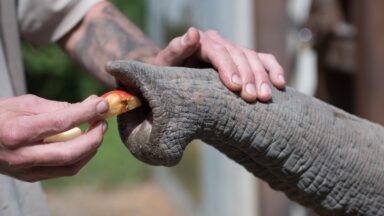
Unique structure of elephant whiskers give them built-in sensing “intelligence”
The trunk of an elephant is an incredible organ, exhibiting remarkable flexibility that allows it to forage for food effectively. This versatility is complemented by its ability to handle delicate items, from peanuts to tortilla chips. Recent research has revealed that the sensitivity of the trunk is significantly enhanced by the unique structure of the whiskers lining it, which contribute to a form of innate 'material intelligence,' according to a study published in the journal Science. The study highlights a long-standing interest in the whiskers, or vibrissae, of various mammals. Previous research has documented similar whisker anatomy across a wide range of species, including rats, cats, and seals, demonstrating the evolutionary importance of these sensory tools. The findings open doors to potential applications, such as the development of artificial whiskers for robotic tactile sensors and deeper insights into human touch. Whiskers are more intricate than they appear, playing crucial roles in sensory perception. For example, rats possess around 30 prominent whiskers and numerous smaller ones, forming a sophisticated 'scanning sensorimotor system.' This system allows rats to perform complex tasks such as analyzing textures, navigating paths, recognizing patterns, and locating objects solely through whisker contact with their surroundings. Although whiskers are essentially specialized hairs made of dead keratin cells, their sensitivity comes from their connection to a network of neurons. Each whisker is anchored in a follicle linked to a 'barrel' containing up to 4,000 densely packed neurons. This arrangement creates a topographic map for the rat's brain, conveying precise information about their environment. Furthermore, the whiskers resonate at specific frequencies, with shorter ones near the nose and longer ones positioned further back, allowing rats to construct a 'frequency map' as they explore their surroundings.
Prentis: Ambitious New AI Lab Eyes $100 Million Funding with Innovative Automation Goals
Prentis, a cutting-edge AI research laboratory co-founded by Ritankar Das, Reid Hoffman, and Marc Pincus, is currently i...
TechCrunch | Jul 24, 2026, 22:45
Kalshi Challenges Netflix Over Controversial Documentary Trailer
Kalshi, the prediction market platform, has taken significant legal steps against Netflix, sending a cease-and-desist le...
TechCrunch | Jul 25, 2026, 17:10
SpaceX's Latest Starlink Launch Marks Milestone Amid Booster Setbacks
On Friday, SpaceX marked a significant achievement by successfully launching its first batch of third-generation Starlin...
TechCrunch | Jul 24, 2026, 23:40
SpaceX Successfully Tests Starship Rocket, Launching New Era of Space Exploration
On Friday evening, SpaceX executed a significant milestone by launching its colossal Starship rocket from its facility i...
CNBC | Jul 25, 2026, 24:10
Vietnam's Controversial Social Media Proposal: A New Approach for Youth Engagement
Vietnam is contemplating a distinctive approach to youth social media regulations, diverging from the more common outrig...
TechCrunch | Jul 24, 2026, 21:25