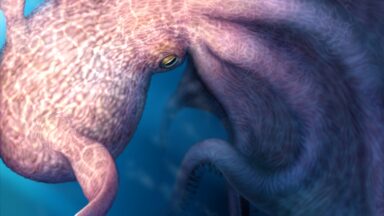
Meet the 19-meter Cretaceous kraken that swam with mosasaurs
Around 80 million years ago, the oceans of the late Cretaceous period were dominated by formidable predators like the 17-meter-long mosasaurs, long-necked plesiosaurs, and enormous sharks. Traditionally, paleontologists believed that vertebrates ruled this ancient aquatic world, with invertebrates relegated to the role of prey. However, groundbreaking research published in Science has unveiled a surprising contender for the apex predator title—an enormous, finned octopus that may have reached lengths of up to 19 meters. These ancient octopuses boasted powerful, hardened beaks and were likely equipped with remarkable intelligence. Yasuhiro Iba, a paleontologist from Hokkaido University and co-author of the study, expressed that prior to this research, the dynamics of Cretaceous marine ecosystems were primarily viewed through the lens of large vertebrate dominance. In contrast, invertebrates were thought to have developed protective adaptations like hard shells to survive predation. The challenge in assessing the role of octopuses in this ecosystem stems from their soft-bodied nature, which makes fossilization exceptionally rare. Typically, when these creatures perish, their soft tissues decompose quickly, leaving little to no trace in the fossil record. The only parts that tend to fossilize are their chitinous jaws, which resemble parrot beaks. However, these beaks are notoriously difficult to locate when encased in dense marine rock. To tackle this problem, Iba and his team introduced an innovative method they termed Digital Fossil Mining. This approach diverged from conventional imaging techniques reliant on X-rays. Instead, they employed high-resolution grinding tomography, which involves meticulously removing tiny layers of rock while photographing each slice. This technique operates like a reverse 3D printer, enabling the team to create detailed, full-color, 3D digital models of the rock's interior. Utilizing an AI model, the researchers analyzed these extensive datasets to identify fossilized remains hidden within. Once identified, the fossils were digitally extracted as 3D models, offering a new perspective on the ancient world and its inhabitants, significantly reshaping our understanding of the Cretaceous food chain.
Vision Breakthrough: US Startup Launches Groundbreaking Retina Chip in Europe
Science Corp is poised to introduce a revolutionary retina chip in Europe, designed to restore partial vision for indivi...
Business Today | Jul 25, 2026, 01:00
Crisis Averted: Power Line Failure Highlights Urgent Need for Data Center Resilience
A power line failure near Washington, DC, recently showcased a significant challenge faced by the electrical grid due to...
TechCrunch | Jul 25, 2026, 13:50
The Rise of AI Distillation: A Controversial Technique Sparks Debate in Tech and Government
In recent discussions, a once-obscure topic in artificial intelligence has surged to the forefront of debates among tech...
CNBC | Jul 25, 2026, 12:15
SpaceX's Latest Starlink Launch Marks Milestone Amid Booster Setbacks
On Friday, SpaceX marked a significant achievement by successfully launching its first batch of third-generation Starlin...
TechCrunch | Jul 24, 2026, 23:40
The Shift in Human Cognition: Embracing AI as a Collaborative Tool
As technology continues to evolve, a notable shift is occurring in the relationship between humans and artificial intell...
Business Insider | Jul 25, 2026, 09:50