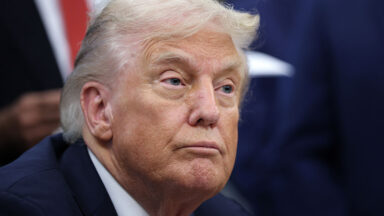
Republicans once again thwart Trump’s push to block state AI laws
A recent effort backed by Donald Trump to establish a federal law preventing states from enacting their own AI regulations has encountered significant resistance in Congress. The proposal aimed to be included in the National Defense Authorization Act (NDAA) but was ultimately rejected, as reported by House Majority Leader Steve Scalise (R-La.) on Tuesday. Several Republican lawmakers have expressed their disagreement with Trump's move, arguing that allowing states to regulate AI as needed is essential for addressing emerging risks. This division within the party has led to a lack of unified support for Trump's initiative, which he argues is necessary to prevent a fragmented regulatory environment that could stifle innovation. For months, Trump has urged the Republican-majority Congress to act against state AI laws, claiming these regulations could hinder the progress of AI companies. However, his calls have not gained the traction he hoped for, as evidenced by previous votes against similar measures in other legislation, including the so-called “Big Beautiful” budget bill. Key Republicans, including Rep. Marjorie Taylor Greene (R-Ga.), Alabama Governor Sarah Huckabee Sanders, and Florida Governor Ron DeSantis, have voiced their opposition to including the AI preemption in the NDAA. Despite the setback, Scalise indicated that the pursuit of a federal standard is not abandoned. He acknowledged the backlash against including the measure in the defense bill and noted that Republicans will explore alternative avenues to advance it in the future. Trump has been vocal about the need for a single federal standard, warning that without it, the United States risks falling behind in the global AI competition, particularly against China. In a statement on Truth Social last month, he emphasized the urgency of the matter, urging Congress to either incorporate the measure into the NDAA or pass it separately to maintain American competitiveness in AI development.
Emerging AI Chip Design Revolution: A Challenge to Nvidia's Reign
Nvidia, under the leadership of Jensen Huang, faces a significant challenge from the very AI technology it helped to pop...
Business Insider | Nov 24, 2026, 10:10Nvidia's CEO Jensen Huang Returns Amid Scandal and Government Intervention
In a surprising turn of events, Nvidia's board has reinstated Jensen Huang as CEO and president just two weeks after his...
TechCrunch | Nov 24, 2026, 13:45
Navigating the AI Landscape: Why CEOs Must Embrace Technology Literacy
In the rapidly evolving world of corporate India, companies are increasingly investing in artificial intelligence (AI), ...
Business Today | Nov 24, 2026, 07:35
realme P4x 5G vs vivo Y31t 5G: Which Smartphone Offers the Best Bang for Your Buck?
When it comes to choosing between the realme P4x 5G and the vivo Y31t 5G, potential buyers are faced with distinct advan...
Business Today | Nov 24, 2026, 01:50
Investing in the Future: Solar and Battery Solutions for AI Data Centers
The challenge of powering AI data centers has emerged as a pivotal issue in the current technological landscape. Over th...
TechCrunch | Nov 24, 2026, 16:25