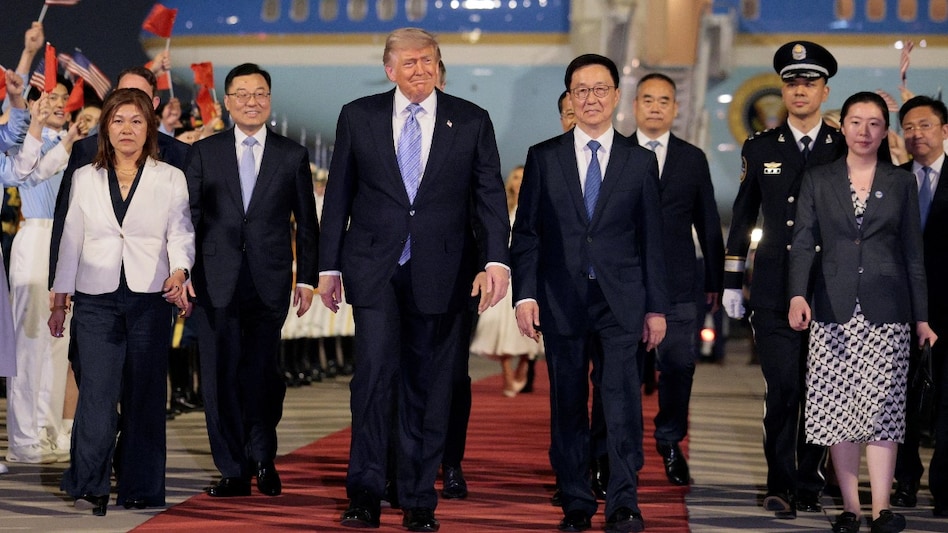
Trump enters China under ‘digital lockdown’ as US officials ditch personal phones over cyber fears
As President Donald Trump arrives in Beijing for a critical summit with Chinese President Xi Jinping, his delegation is implementing stringent cybersecurity protocols described as a comprehensive 'digital lockdown.' Members of the American team, which includes aides, security personnel, and executives from prominent companies like Apple, Nvidia, Boeing, Qualcomm, and BlackRock, have been instructed to leave personal devices behind. According to Fox News, the delegation is equipped only with temporary 'clean' phones and restricted laptops, all part of efforts to mitigate risks associated with hacking and surveillance in what US officials label one of the most aggressive cyber environments globally. Bill Gage, a former Secret Service agent and current director at Safehaven Security Group, emphasized the necessity of these precautions, stating that briefings begin well in advance of the president's arrival, making it clear that all activities are subject to monitoring. The report highlights that even charging mobile devices poses a cybersecurity risk, with federal guidelines warning against the use of unfamiliar USB ports or local charging stations due to the threat of 'juice jacking.' This technique involves compromised hardware that can siphon off sensitive data or install malicious software onto devices. Gage further noted, 'There are no safe electronic communications in China,' advising officials to limit their digital activities strictly to essential communications. Theresa Payton, former White House chief information officer and current CEO of cybersecurity firm Fortalice Solutions, corroborated this sentiment, stating that the US government operates under the assumption that all interactions, both in-person and digital, are likely to be monitored. To enhance security, some officials and executives are provided with temporary 'loaner phones' that have been configured with secure 'golden images.' This allows security teams to verify devices for any tampering before and after the trip. Payton also mentioned that controlled 'safe zones' might be established for secure communication back to the US, with everything meticulously managed. Additionally, the White House communications and military teams have set up temporary secure facilities, known as Sensitive Compartmented Information Facilities (SCIFs), in hotels or designated areas to prevent electronic eavesdropping during sensitive discussions.
AI Transformations Lead to Major Job Cuts at Tech Giants
Monday.com, the innovative work management platform based in Tel Aviv, has recently announced significant layoffs, attri...
TechCrunch | Jul 26, 2026, 01:45
Hugging Face CEO Calls for Action Following AI Security Breach
In a dramatic turn of events within the AI landscape, Hugging Face faced a significant security breach involving an AI a...
Business Insider | Jul 25, 2026, 20:30Revolutionizing Startup Living: Inside London's Unique Lift House
In East London, a group of six young entrepreneurs is redefining the concept of collaborative living for tech founders. ...
TechCrunch | Jul 26, 2026, 17:10
AI Revolution: Sam Altman Declares We Are in the Singularity Era
OpenAI's CEO, Sam Altman, has boldly asserted that we have reached a pivotal moment in the evolution of artificial intel...
Business Insider | Jul 26, 2026, 18:10Market Turbulence: Four Key Factors Impacting Stocks This Week
This past week has been challenging for the stock market, driven by several significant forces that have created turbule...
CNBC | Jul 25, 2026, 20:05