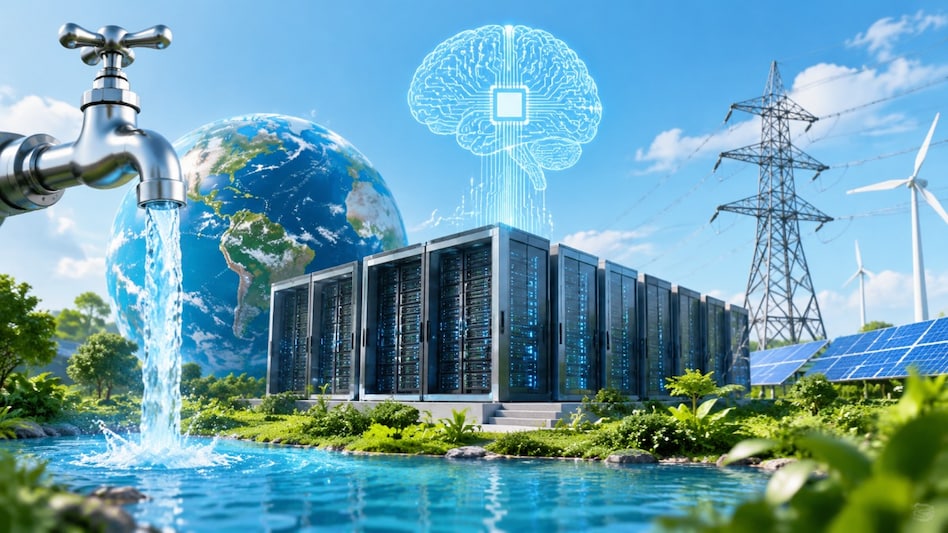
Using AI could have a hidden cost: Water needed by 1.3 billion people
As artificial intelligence continues to integrate into daily life, facilitating faster work, learning, and content creation, a new report from the United Nations University (UNU) raises alarming concerns regarding its environmental footprint. The study highlights the significant demand for water and energy associated with the rapid growth of AI technologies, warning that this could lead to severe ecological challenges in the near future. By the year 2030, data centers essential for powering AI systems may consume enough water to satisfy the basic domestic needs of approximately 1.3 billion individuals, a number comparable to the entire population of Africa. This staggering statistic underscores the often-overlooked water consumption linked to AI, overshadowed by the more frequently discussed carbon emissions. The UNU report indicates that substantial water is required for cooling servers and generating the electricity necessary for operating advanced AI models. Furthermore, it forecasts that AI-driven data centers could use a staggering 945 terawatt-hours of electricity annually by 2030, nearly three times the total yearly electricity consumption of Pakistan, Bangladesh, and Nigeria combined. This increasing demand for computing power is placing immense strain on global energy systems. The study emphasizes that AI is not merely a digital phenomenon; it is supported by a complex physical infrastructure comprising data centers, sophisticated chips, cooling systems, and energy networks. Constructing and maintaining this infrastructure demands vast resources, including land, water, and electricity. One particularly striking revelation from the report is that everyday interactions with AI may consume more energy than the initial training of AI models. Researchers estimate that routine usage accounts for about 80 to 90 percent of the total energy demand, with tasks like image and video generation requiring significantly more energy than simple text-based requests. In light of these findings, the United Nations University and the UN advocate for a balanced approach to AI development. They emphasize the importance of considering the environmental impact of water, land, and energy in conjunction with technological advancement, urging governments, tech companies, and users to embrace responsible practices as AI continues to evolve.
The Rise of AI Distillation: A Controversial Technique Sparks Debate in Tech and Government
In recent discussions, a once-obscure topic in artificial intelligence has surged to the forefront of debates among tech...
CNBC | Jul 25, 2026, 12:15
Market Turbulence: Four Key Factors Impacting Stocks This Week
This past week has been challenging for the stock market, driven by several significant forces that have created turbule...
CNBC | Jul 25, 2026, 20:05
The Future of Work: Executives Weigh In on AI's Impact on Gen Z Careers
As generative artificial intelligence continues to rise, uncertainty looms for the incoming Gen Z workforce. Leaders fro...
Business Insider | Jul 26, 2026, 10:15Shifting Focus: The Cost-Effectiveness of AI Models Takes Center Stage
In recent years, the AI sector has been intensely focused on identifying the most advanced models. While this pursuit re...
Business Insider | Jul 25, 2026, 13:10Navigating the Future: Are Wearable AI Gadgets Ready to Transform Our Lives?
Imagine a typical workday where you and your colleagues sport discreet recorders on your clothing, while smart glasses s...
CNN | Jul 26, 2026, 16:10