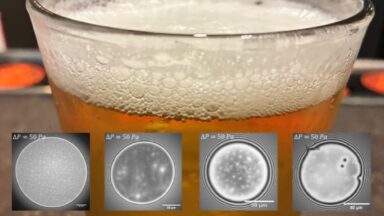
Physics of why Belgian beer foam is so stable
For enthusiasts of beer, a thick and lasting foam head is a quintessential part of the drinking experience. Researchers from Switzerland dedicated seven years to unraveling the mystery of why certain beers maintain their foam better than others. Their findings, published in Physics of Fluids, highlight the importance of fermentation levels—whether a beer undergoes single, double, or triple fermentation plays a significant role in foam stability. Foams are a common phenomenon, present in various aspects of daily life, from whipped cream and cappuccinos to shaving cream and even packing materials. They are generated when air is incorporated into a liquid that contains surfactants—substances that enhance the stability of the bubble walls. Typically, these surfactants are fats or proteins in food-related foams, while non-edible foams may contain chemical additives. The shape of individual bubbles is generally spherical, as this form minimizes surface area for a given volume, making it the most energy-efficient configuration. This principle also allows bubbles to pack tightly together, forming a foam. However, as time passes, bubbles tend to 'coarsen' due to gravity, which pulls down on the liquid and thins the walls of the bubbles. Consequently, they begin to resemble soccer balls, or polyhedrons. In the process of coarsening, smaller bubbles are absorbed by larger ones, leading to a situation where less liquid separates them, causing the bubbles to press together. This phenomenon, referred to as 'jamming,' explains why foams can exhibit rigidity despite being composed of 95% gas and only 5% liquid. The closer the bubbles cluster, the less mobility they have, raising the internal pressure and giving the foam solid-like properties. Several factors influence foam stability. For instance, a 2019 study from Japan introduced the concept of 'collective bubble collapse' (CBC), where the rupture of one bubble can trigger a chain reaction, affecting neighboring bubbles. The researchers identified two mechanisms involved in this process: the 'propagating mode,' where a broken bubble merges back into the liquid film, and the 'penetrating mode,' where bursting bubbles send droplets that impact and cause adjacent bubbles to collapse. These insights into foam dynamics not only enhance our appreciation of beer but also have broader implications in various fields, including food science and material engineering.
China's Helium Export Ban Sparks Concerns in Semiconductor Sector Amid Supply Chain Strains
The semiconductor industry is facing a new challenge as China's recent temporary ban on helium exports intensifies exist...
Business Today | Jul 16, 2026, 05:10
Lululemon Fuels Innovation with $30M Investment in Nylon Recycling Pioneer Syntetica
Lululemon, the well-known activewear brand, has made a significant investment in Syntetica, a French startup that has de...
TechCrunch | Jul 16, 2026, 04:30
Emergent's Vision: The Future of Developers in an AI-Driven World
As artificial intelligence transforms the landscape of software engineering, Mukund Jha, the CEO and co-founder of Emerg...
Business Insider | Jul 15, 2026, 19:45AI's Role in the Workforce: Why Some Jobs Remain Safe from Automation
As artificial intelligence reshapes various industries, the replacement of many front-line workers by robots remains a c...
Business Today | Jul 16, 2026, 02:00
Revolutionizing Energy: Applied Computing Secures $20 Million to Transform Oil and Gas Operations with AI
Applied Computing, a London-based startup pioneering AI solutions for the oil, gas, and petrochemical industries, has su...
TechCrunch | Jul 16, 2026, 04:30