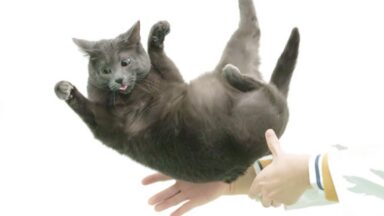
Tuck and turn, or bend and twist? How falling cats land on their feet.
Why do cats have the uncanny ability to land gracefully on their feet after a fall? This intriguing question has captivated scientists for centuries, sparking debates and extensive research dating back to the 1700s. A recent study published in The Anatomical Record delves into the mechanics of feline flexibility, adding new insights to this long-standing mystery. Notably, the phenomenon was highlighted in 2019 when physicist Greg Gbur from the University of North Carolina, Charlotte, released his book, "Falling Felines and Fundamental Physics." Historically, many believed it was impossible for a cat to right itself mid-fall, until French physiologist Etienne-Jules Marey stunned the scientific community with high-speed photographs demonstrating a cat landing on its feet in 1894. Gbur, however, underscores that cats are complex living beings rather than simple mechanical objects, making their falling motion intricate. Over the years, four primary theories have emerged to explain how they achieve this impressive feat. The first is the “tuck and turn” model, which describes how a cat draws in its limbs to allow for body rotation. The second theory, proposed by physicist James Clerk Maxwell in the 19th century, likens a cat’s maneuver to that of a figure skater who adjusts their angular momentum by repositioning their arms and legs. The third hypothesis is known as “bend and twist,” where the cat bends its body at the waist to facilitate rotation of its segments. Lastly, the “propeller tail” theory suggests that a cat can alter its rotational direction by moving its tail like a propeller. While Gbur previously emphasized the significance of the bend-and-twist motion, his latest research indicates a re-evaluation of the tuck-and-turn mechanism, suggesting it plays a crucial role as well. In his recent blog post, Gbur acknowledged that while various movements contribute to the cat's ability to right itself, the tuck-and-turn approach deserves more attention than he initially gave it.
Infosys Appoints Veteran Leader to Navigate the AI Landscape
Infosys has made a significant move by naming Ashiss Kumar Dash, a long-time company insider, as its next Chief Executiv...
Business Today | Jul 24, 2026, 15:25
Bluesky's Attie Transforms into a Comprehensive Research Tool
Bluesky's AI assistant, Attie, is taking a significant leap forward by evolving into a versatile research tool aimed at ...
TechCrunch | Jul 24, 2026, 15:25
Cognition Acquires Poke: Redefining AI Interaction for Enhanced Productivity
Poke, the friendly AI assistant that users interact with as if chatting with a friend, is set to embark on a new journey...
TechCrunch | Jul 24, 2026, 18:25
Trump Signals Trade War with EU Over Tech Giants' Fines
In a bold move, President Donald Trump announced on Friday that his administration would initiate a trade investigation ...
CNBC | Jul 24, 2026, 18:15
Legal Battle Erupts Over 'Duress' Password in Groundbreaking Data Wiping Case
The U.S. Justice Department has initiated legal proceedings against a Georgia resident, Samuel Tunick, who is accused of...
TechCrunch | Jul 24, 2026, 18:25