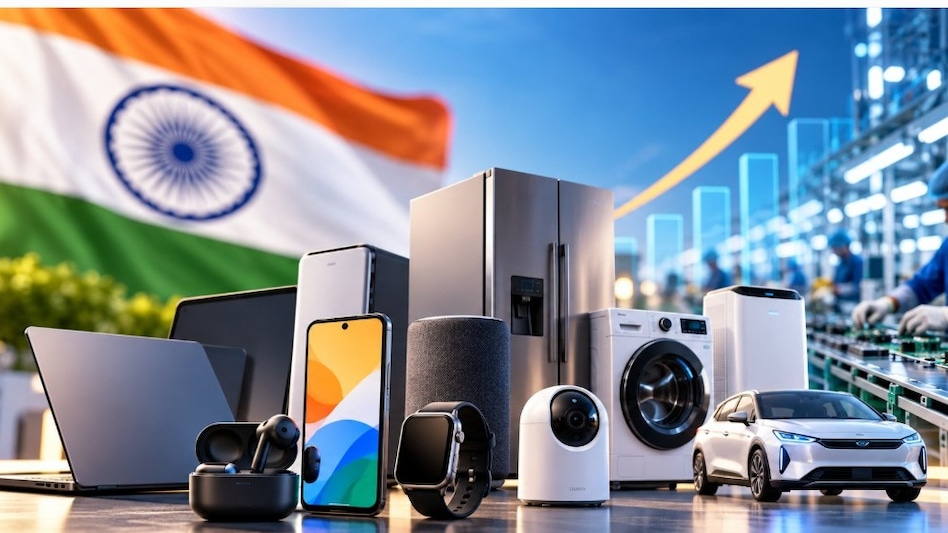
India has 129 homegrown tech brands earning ₹60,000 crore, but why are so few scaling up?
India boasts 129 tech brands in sectors such as gadgets, devices, appliances, and connected vehicles, collectively generating over ₹60,000 crore in annual revenue. However, only 14 of these brands surpass ₹500 crore in earnings, with merely two exceeding ₹2,000 crore. This stark reality underscores the difficulties faced by Indian companies striving to scale their technology ventures, as noted in the Viksit Tech 47 Report 2026, published by India Mobile Congress and Techarc. The report reveals an average annual revenue of approximately ₹465 crore per brand, indicating that a large portion of India's homegrown consumer technology sector remains anchored in relatively small enterprises. According to Faisal Kawoosa, chief analyst and co-founder of Techarc, many of these brands are still in the nascent stages of development, primarily engaged in trading or assembling products rather than engineering them. To understand the scaling dilemma, the report introduces the TAME model, which tracks the evolution of brands from Trade to Assemble, Manufacture, and Engineer. Research by Techarc indicates that brands that focus on trading finished products often hit a revenue ceiling around ₹500 crore. In contrast, those engaged in assembly seldom surpass ₹5,000 crore, while manufacturing-focused enterprises can scale up to approximately ₹50,000 crore. The report further emphasizes that substantial revenues are typically generated by brands that engineer their own products and possess their design, software, and intellectual property. However, it warns that this transition is neither straightforward nor guaranteed. Many brands remain stagnant at certain stages for years and may fail when faced with intensified competition, rapid product cycles, or diminishing capital. The challenges faced by Indian technology brands are illustrated by the handset industry’s experience in the early 2010s, where various domestic players achieved significant scale through trading but struggled to ascend the value chain amid the arrival of better-funded global competitors. Despite a surge in India's overall manufacturing, the success has not been mirrored in the performance of local brands. Electronics production increased from ₹1.90 lakh crore in FY2014-15 to ₹13.11 lakh crore in FY2025-26, with exports reaching ₹4.24 lakh crore. Yet, domestic value addition in the electronics sector remains around 17%, as India continues to rely on imports for critical components such as displays, semiconductors, camera modules, and battery cells. Moreover, the report highlights the low investment in product engineering, industrial design, and intellectual property, compounded by limited access to patient, long-term capital for hardware and deep-tech ventures. Despite the growth of the manufacturing sector, Indian brands command only a modest share of the domestic smartphone market. To overcome these challenges, the report advocates for India to shift from merely manufacturing for global companies to building its own brands that own their products, technology, and intellectual property. It stresses the necessity for increased collaboration between startups and educational institutions, enhanced component localization, improved access to growth capital, and support for international distribution. With an anticipated annual growth rate of 13%, the combined revenue of these 129 brands could soar to ₹1.11 lakh crore by FY2031 and ₹2.04 lakh crore by FY2036. The report sets an ambitious goal for 2047: to establish 50 Indian technology brands, each generating upwards of ₹1 lakh crore annually. Achieving this vision will necessitate significant progress for more companies from trading and assembly to product engineering and competing on a global scale.
Investing in the Future: Solar and Battery Solutions for AI Data Centers
The challenge of powering AI data centers has emerged as a pivotal issue in the current technological landscape. Over th...
TechCrunch | Nov 24, 2026, 16:25
Saudi Engineer Faces Legal Battle Over Alleged Espionage Using AI Tech
A Saudi engineer employed by OpenAI, Abdulrahman Alfozan, is at the center of a legal dispute as prosecutors allege he u...
Business Insider | Nov 23, 2026, 23:50Figma Engineer Files Lawsuit Claiming Workplace Harassment and Retaliation
A former engineer at Figma has initiated legal action against the design software firm and its CEO, Dylan Field, citing ...
TechCrunch | Nov 23, 2026, 23:15
Staggering Recovery Rates Highlight Digital Payment Fraud Challenges
The battle against digital payment fraud continues to be an uphill struggle for consumers, with official data revealing ...
Business Today | Nov 24, 2026, 09:30
Nvidia's CEO Jensen Huang Returns Amid Scandal and Government Intervention
In a surprising turn of events, Nvidia's board has reinstated Jensen Huang as CEO and president just two weeks after his...
TechCrunch | Nov 24, 2026, 13:45