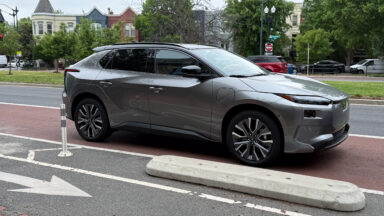
2026 Subaru Solterra review: The badge-engineered bZ ain’t bad
Subaru's electrification journey is gaining momentum with the introduction of new electric vehicles this year, including the Uncharted and the Trailseeker. While these models are not entirely developed in-house, they utilize Toyota’s e-TNGA platform, similar to the earlier Solterra EV. The Solterra continues to be available alongside these newcomers, offering a larger size compared to the Uncharted and a more urban-friendly design than the Trailseeker. Recently, the Solterra received a midlife refresh, prompting us to spend some time behind the wheel. The initial version of the Solterra had its shortcomings, with an average design that was unmistakably Subaru on the outside but bore a Toyota influence in the interior. Performance-wise, it struggled with efficiency and charging speed, making it less competitive against rivals like the Hyundai Ioniq 5. However, the updated Solterra version 1.1 brings significant improvements. The new design features a fresh look—some might even say it resembles an Autobot—and the technical specifications have seen noteworthy enhancements. With a battery capacity now at 74.7 kWh, only a slight increase from the previous model, the EPA range has impressively jumped from 227 miles (365 km) to 288 miles (463 km). Remarkably, this boost in range does not come at the expense of power; the standard Solterra now delivers 233 hp (174 kW) from its dual motors. Additionally, Subaru has introduced the Solterra XT, which significantly elevates power output—its front motor now generates 223 hp (167 kW) combined with the rear motor's 117 hp (87 kW), resulting in a total of 338 hp (252 kW). However, the XT version does come with a slightly reduced range estimate of 278 miles (447 km). Pricing reflects these enhancements, with the base Solterra starting at $38,495, while the Solterra XT begins at $42,895. Beneath the updated exterior, numerous improvements have been made, particularly in suspension and chassis control systems. Subaru claims that these revisions enhance performance on rough terrain and low-grip surfaces, although our test drive primarily focused on city streets and imperfect roads. The vehicle demonstrated a smooth ride, and the added body stiffness along with sound-absorbing materials effectively minimized noise and vibrations, contributing to an overall enjoyable electric driving experience.
OpenAI's Micro Keypad: A Novelty for Coders or Just a Confounding Gadget?
Last week, OpenAI made its debut in the hardware landscape with the launch of Micro, a stylish keypad designed to integr...
TechCrunch | Jul 25, 2026, 24:40
SpaceX Successfully Tests Starship Rocket, Launching New Era of Space Exploration
On Friday evening, SpaceX executed a significant milestone by launching its colossal Starship rocket from its facility i...
CNBC | Jul 25, 2026, 24:10
Prentis: Ambitious New AI Lab Eyes $100 Million Funding with Innovative Automation Goals
Prentis, a cutting-edge AI research laboratory co-founded by Ritankar Das, Reid Hoffman, and Marc Pincus, is currently i...
TechCrunch | Jul 24, 2026, 22:45
Revolutionizing Office Automation: Prentis Aims to Secure $100 Million in Funding
Prentis, a newly established AI research lab, is making waves in the tech industry as it prepares to raise $100 million ...
TechCrunch | Jul 25, 2026, 24:00Rising Concerns in Bond Market as AI Investments Surge
Investors are growing increasingly uneasy about the substantial capital required to realize the ambitions of artificial ...
CNBC | Jul 24, 2026, 20:15