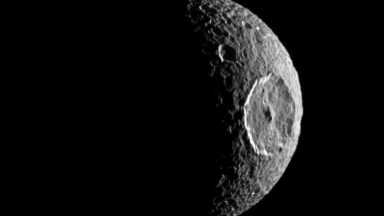
Formation of oceans within icy moons could cause the waters to boil
Recent investigations into the outer Solar System have unveiled a variety of icy moons, many of which showcase intriguing geological features. These characteristics—especially exemplified by Enceladus's spectacular geysers—indicate that there may be hidden oceans beneath their frozen surfaces. The formation of these oceans is primarily attributed to gravitational forces that exert flexing and friction on the moons, generating sufficient heat to melt their interiors. Interestingly, many of these gravitational interactions are not permanent; they often occur in cycles. The orbits of celestial bodies are rarely uniform and frequently undergo long-term variations. This phenomenon is also observed among the moons that exert gravitational influence. Consequently, the internal oceans of these moons may not be stable; they could undergo phases of melting and refreezing as the moons’ interiors alternately warm and cool. A groundbreaking study published in Nature Astronomy today explores a fascinating consequence of the density difference between liquid water and ice—approximately 10 percent. It suggests that as a moon melts, its interior could shrink, creating a low-pressure zone directly beneath its icy exterior. If the moon is sufficiently small, this condition could lead to the boiling of the ocean's surface. While it might be tempting to regard the current layout of the Solar System as static, that is far from the truth. Evidence suggests that the outer planets have shifted positions throughout their history. Even in its current state, Earth experiences long-term orbital cycles that influence its transitions into and out of ice ages. The moon systems surrounding the outer planets are likely to have even more intricate interactions, with various bodies of differing sizes coexisting alongside massive giants. Thus, it's easy to assume that any existing oceans are the result of constant forces, and that they have always been there. Alternatively, one might think these moons began as hot entities and have been cooling over time. However, the reality is more complex; the tidal heating responsible for the emergence of these oceans can fluctuate over time, causing the moons to experience cycles of melting and freezing.
Patreon Takes a Stand Against AI Content Scrapers with New Blocking Measures
Patreon, the popular membership platform catering to content creators, is intensifying its efforts to prevent artificial...
TechCrunch | Jul 17, 2026, 15:50
Databricks Achieves $188 Billion Valuation Amid AI Revolution
Databricks has announced a significant new funding round that values the company at an impressive $188 billion, followin...
TechCrunch | Jul 17, 2026, 22:15
Xi Jinping Advocates for Open-Source AI Collaboration at Global Conference
At the World Artificial Intelligence Conference held in Shanghai, Chinese President Xi Jinping emphasized the necessity ...
Business Insider | Jul 17, 2026, 17:10Meta Explores AI Infrastructure Leasing Deal with Anthropic
Meta is currently in discussions with the AI startup Anthropic regarding the potential leasing of its extensive computin...
CNN | Jul 17, 2026, 21:15
Florida Man Arrested for Allegedly Using Malware-Infested Games to Steal Cryptocurrency
U.S. authorities have taken a significant step in combatting cybercrime with the arrest of a 21-year-old Florida residen...
TechCrunch | Jul 17, 2026, 16:45