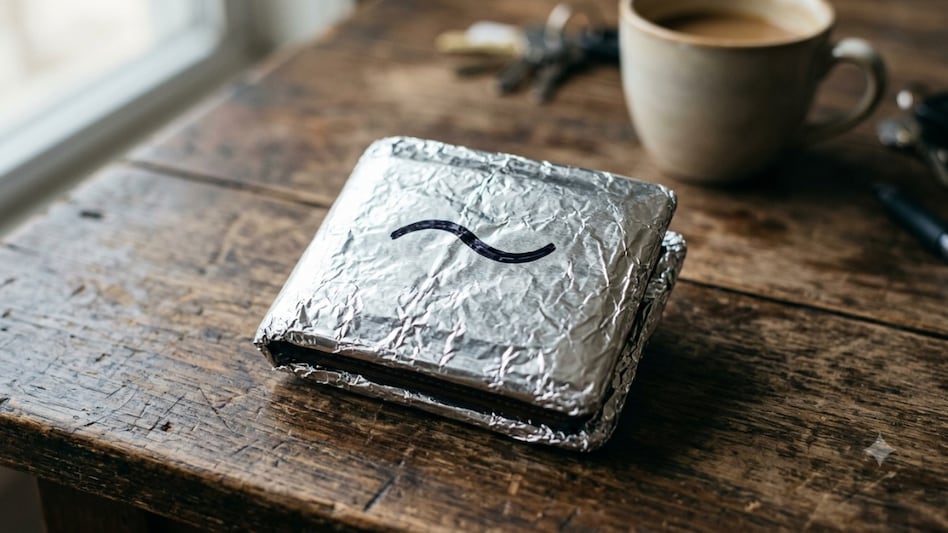
Why are people wrapping their wallets in aluminium foil? Viral hack to block wireless theft explained
Have you noticed an unusual trend where people are wrapping their wallets in aluminum foil? This peculiar practice has emerged as a creative solution to safeguard personal information from wireless scanning. By enveloping wallets in aluminum foil, individuals aim to block contactless cards and RFID (Radio Frequency Identification) or NFC (Near Field Communication) enabled IDs from being scanned without consent. In today's digital age, wallets are not just for cash and credit cards; they also hold a variety of RFID-enabled items, including driver's licenses, passport cards, and transit passes. This technology allows for fast, tap-and-pay transactions and convenient access. However, the convenience comes with a risk: specialized RFID readers can potentially read these wireless signals without the owner's knowledge. Although large-scale wireless theft of payment cards is rare, unauthorized reading of RFID-enabled documents raises significant privacy concerns. Reports indicate that certain RFID-enabled IDs, such as enhanced driver's licenses in the United States, can transmit unique identification numbers over distances much greater than most people might expect. The ACLU of Washington has pointed out that these IDs can be scanned from as far as 162 feet away under ideal conditions using commercial RFID readers. So, how does aluminum foil come into play? This common household item is a conductive material capable of blocking or weakening radio waves. When wrapped around a wallet, it functions as a shield, preventing radio-frequency signals from entering or exiting. This DIY method complicates the ability of RFID readers to interact with the chips contained in the wallet. However, it’s important to note that while aluminum foil can diminish RFID signals, it does not eliminate all cybersecurity risks. The likelihood of money being wirelessly stolen from contactless debit or credit cards is relatively low, as these cards incorporate various security measures such as encryption and authentication. Nevertheless, some government-issued RFID documents can be more easily read from a distance, posing a more significant privacy issue compared to standard bank cards.
Jensen Huang's Remarkable Comeback: A Look at Corporate Resurgences
Jensen Huang has made headlines with his return to the helm of Nvidia on November 23, merely 11 days after stepping down...
Business Today | Nov 24, 2026, 20:15
Former OpenAI Engineer Granted Release on Bond Amid Espionage Allegations
Abdulrahman Alfozan, the ex-OpenAI engineer who was terminated and subsequently arrested last month, is poised to be rel...
Business Insider | Nov 24, 2026, 20:40Anthropic's Stock Plummets, Raising Concerns for the AI Sector
Shares of Anthropic have dipped below their initial public offering (IPO) price of $83, reaching a low of $76 by midday ...
TechCrunch | Nov 24, 2026, 18:45
Cybersecurity Alert: Iranian Hackers Target Shipping Vessels in Surge of Attacks
U.S. authorities are investigating a series of cyberattacks on shipping vessels, with suspicions pointing toward Iranian...
TechCrunch | Nov 24, 2026, 21:15
Amazon's $7.5 Billion Acquisition of Decart: A Strategic Move in the AI Chip Landscape
In a significant development for the tech industry, Amazon has announced its acquisition of Decart, a startup specializi...
TechCrunch | Nov 24, 2026, 15:55