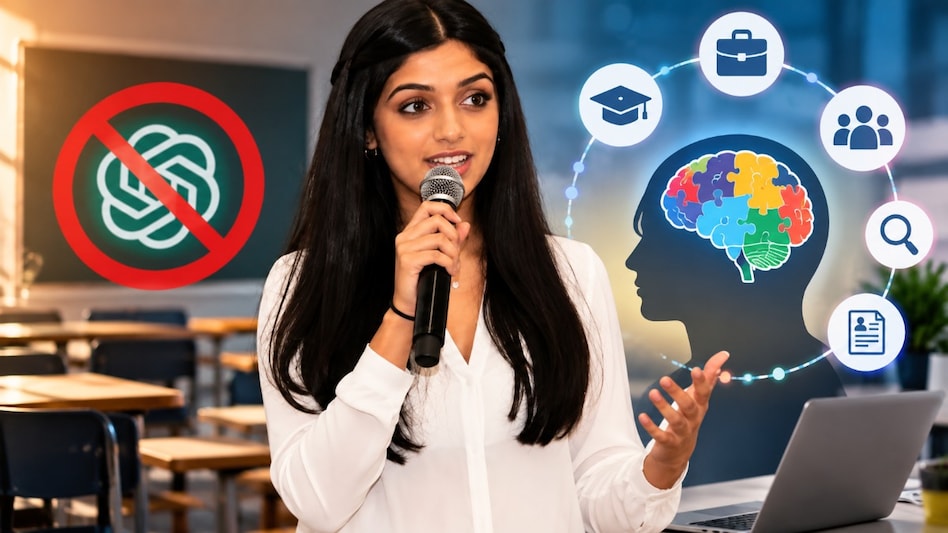
Meet Navya Tuteja: Her school blocked ChatGPT, but this 17-year-old built an AI startup to help neurodivergent people find the right jobs
At just 17 years old, Navya Tuteja, a high school senior from the United States, has made waves in the tech world by launching an AI startup that has attracted over 1,000 users and features 20,000 job listings. This remarkable achievement comes despite her school’s restrictions on accessing AI tools like ChatGPT and Claude. Tuteja, a student at Thomas Jefferson High School for Science and Technology near Washington, D.C., introduced her platform, Raaha, only two months ago. The innovative service is designed to assist neurodivergent individuals in evaluating job listings to determine their suitability before applying. The inspiration for Raaha stemmed from her mother’s experiences with partial hearing loss and Tuteja’s observation that many job postings fail to communicate the actual nature of the work, focusing instead on employer expectations. Raaha employs a scoring system that assesses job listings across various criteria, offering candidates a clearer understanding of the roles they are considering. Tuteja has funded the startup independently and intends to keep it free for users as it gains popularity. Future monetization could involve partnerships with employers and workforce organizations looking to enhance their job listings. Interestingly, the ban on AI tools at her school has shaped Tuteja's perspective on technology use. While she acknowledges the restrictions limited her AI usage during school hours, she also views this as a positive influence. "It made me use it in school way less. So I guess, as annoying as it was, it was still good, in a way," she explained. Tuteja, who leads her school's AI club, maintains a disciplined approach to learning, opting not to use AI for her academic assignments. Instead, she has developed Raaha's core algorithm herself, utilizing AI primarily for routine tasks like website design improvements. "I try to do all my learning myself, especially for stuff I have exams for," she stated. As AI integration in education grows, recent polling by RAND shows that the proportion of students using AI for homework surged from 48% to 62% within a matter of months. However, many students express concerns about its impact on critical thinking skills. In addition to Raaha, Tuteja has created Legible, a tool that simplifies special education documents like IEPs and 504 plans into more accessible language. This initiative arose from her recognition that AI-generated summaries often fail to include essential sourcing for parents. Tuteja is advocating for a new transparency standard, dubbed Traceable Accessibility, which she has presented to local state senators and discussed with the U.S. Department of Education. While she supports the regulation of AI, she firmly believes that outright bans in educational settings are not the solution, stating, "I think you have to regulate it in the right way." Looking ahead, Tuteja plans to pursue higher education but remains open to dedicating herself full-time to Raaha if its growth continues at this pace.
Investing in the Future: Solar and Battery Solutions for AI Data Centers
The challenge of powering AI data centers has emerged as a pivotal issue in the current technological landscape. Over th...
TechCrunch | Nov 24, 2026, 16:25
Pinterest Empowers Parents with New Controls Over AI Content for Teens
This week, Pinterest unveiled an enhancement to its parental controls, introducing a feature that allows parents to regu...
TechCrunch | Nov 24, 2026, 16:25
Navigating the AI Landscape: Why CEOs Must Embrace Technology Literacy
In the rapidly evolving world of corporate India, companies are increasingly investing in artificial intelligence (AI), ...
Business Today | Nov 24, 2026, 07:35
Staggering Recovery Rates Highlight Digital Payment Fraud Challenges
The battle against digital payment fraud continues to be an uphill struggle for consumers, with official data revealing ...
Business Today | Nov 24, 2026, 09:30
Emerging AI Chip Design Revolution: A Challenge to Nvidia's Reign
Nvidia, under the leadership of Jensen Huang, faces a significant challenge from the very AI technology it helped to pop...
Business Insider | Nov 24, 2026, 10:10