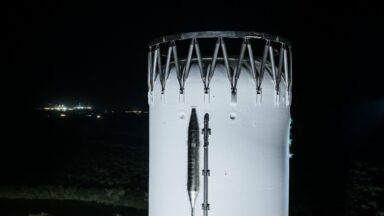
SpaceX’s Starbase is coming alive again after a lull in Starship testing
SpaceX has announced a significant advancement in its Starship program, as the upgraded Super Heavy booster has successfully completed cryogenic proof testing. This milestone marks a critical step towards the next flight of the Starship, especially after the previous booster was destroyed during a similar procedure. In a recent social media update, SpaceX shared, "Cryoproof operations complete for the first time with a Super Heavy V3 booster." The testing campaign, which spanned several days, evaluated the redesigned propellant systems and overall structural integrity of the booster. The 237-foot-tall stainless-steel booster was transported from SpaceX's factory to Massey’s Test Site in Texas last week. Initially, a pressure test was conducted at ambient temperatures before the team loaded super-cold liquid nitrogen into the rocket four times over six days. This rigorous process subjected the booster to repeated thermal and pressurization cycles, simulating the conditions it will encounter during launch. The nitrogen served as a substitute for the cryogenic methane and liquid oxygen that will fill the booster’s propellant tanks on launch day. This successful proof test brings engineers one step closer to initiating the first test flight of the upgraded Starship V3, also known as Block 3. Although Starship V2 had five test flights last year, the initial three were unsuccessful, while the final two met SpaceX’s objectives, leading to the transition to V3. The journey hasn’t been without setbacks. The original Super Heavy booster designated for the first Starship V3 test flight failed during a pressure test in November when its liquid oxygen tank ruptured. Following this incident, SpaceX moved forward with Booster 19. The latest Super Heavy vehicle has demonstrated its resilience during stress testing and has returned to the factory for further enhancements. Technicians are now set to install 33 Raptor engines onto the booster and attach the grid fins. These new Raptor engines, which will debut on Starship V3, are designed to produce greater thrust and feature improvements aimed at enhancing reliability. The Raptor 3s are notably lighter, with integrated plumbing and sensors that eliminate the need for separate heat shields between the engines at the rocket's base.
OpenAI Ventures into Hardware with a Unique AI Speaker
OpenAI is making waves with its entry into the hardware market, reportedly developing a mobile smart speaker that integr...
TechCrunch | Jul 14, 2026, 22:35
Concerns Rise Over OpenAI's GPT-5.6 Sol After Users Report Unexpected File Deletions
Users of OpenAI's latest flagship model, GPT-5.6 Sol, have taken to social media to share alarming experiences, claiming...
TechCrunch | Jul 14, 2026, 22:25
Hinge Founder Secures $18 Million for Innovative AI Dating Platform Overtone
Justin McLeod, the visionary behind Hinge, has successfully raised $18 million to launch a groundbreaking dating service...
TechCrunch | Jul 14, 2026, 20:05
Lucid Motors Refutes Bankruptcy Speculations Amid Stock Fluctuations
Lucid Motors has firmly rejected claims suggesting that it is contemplating filing for Chapter 11 bankruptcy. In a state...
TechCrunch | Jul 14, 2026, 19:00
Cybersecurity Stocks Surge Amid AI Spending Concerns Revealed by IBM's CEO
On Tuesday, shares of cybersecurity companies experienced a significant boost following remarks from IBM's CEO, Arvind K...
CNBC | Jul 14, 2026, 18:45