
The three hard-tech moonshots fueling SpaceX’s unbelievable IPO
As SpaceX prepares to enter the public market this Friday, investor enthusiasm is palpable. The company's stock offering, valued at approximately $75 billion, has reportedly attracted overwhelming interest, with institutional investors ready to invest up to $10 billion in Elon Musk's ventures. Despite the excitement, there are considerable reasons for caution: large IPOs often struggle post-launch, SpaceX is currently operating at a loss, and Musk’s unpredictable social media presence raises eyebrows. Yet, investors seem undeterred, as many have learned that betting against Musk can be risky. A closer examination of SpaceX’s financial strategies reveals a bold plan focused on orbital data centers, a vision that Musk has sought to unify his company before its IPO. This plan hinges on accomplishing three ambitious engineering feats: creating a reusable rocket, establishing a new American chip manufacturing facility, and rapidly producing satellites. Evaluating this business model presents challenges. Recent analyses from financial firm Morningstar and NYU professor Aswath Damodaran suggest that SpaceX’s actual value may be significantly lower than the nearly $1.8 trillion figure proposed by its bankers. Morningstar estimates the company at about $825 billion, while Damodaran values it at around $1.2 trillion. The disparity highlights the risks associated with integrating a dominant space operation with a more uncertain AI business. Morningstar's report points out a stark contrast between its fair-share valuation of $63 and SpaceX’s expected offering price of $135, framing this difference as a speculative bet on the company's ability to deliver orbital data centers as envisioned by Musk. The lucrative margins from SpaceX's satellite internet services and space launch operations are appealing, yet the prospects for its AI initiatives remain unclear. Within its market analysis, SpaceX identifies significant opportunities in enterprise AI, particularly through technologies developed by a team it acquired from Cursor, aimed at empowering digital agents for office tasks. The company estimates the market potential for this AI sector at $22.7 trillion, dwarfing the projected $2.4 trillion for AI infrastructure and under $2 trillion for its space initiatives. However, this outlook seems contradictory when considering SpaceX's recent agreements to provide computing power to competitors like Anthropic and Google. Musk’s recent statements indicate that SpaceX is uniquely positioned to succeed in the realm of data centers in space, claiming it can deliver substantial mass into orbit at lower costs. While industry insiders generally foresee large-scale space data centers being a decade away, Musk asserts that they could be realized sooner, albeit with many caveats. He mentioned aspirations to achieve a production rate of approximately 6,666 satellites per year, significantly higher than current Starlink production levels. To meet these ambitious targets, SpaceX must finalize its solar panel production facility and construct its new chip foundry, which presents its own set of challenges. Additionally, the success of this venture relies heavily on the development and operational reliability of the Starship, which remains in testing. Although recent flights have shown promise, the path to rapid reusability is still uncertain, and the company is currently under investigation by the FAA due to a failed booster reentry. As public investors prepare to acquire shares in SpaceX, they will be buying into a unique portfolio that includes a near-monopoly on U.S. and European space access, a global communications network, and a risky bet on the future of AI infrastructure. Achieving these ambitious objectives requires SpaceX to innovate in areas where no company has succeeded before, particularly in creating a fully reusable rocket and rapidly scaling production facilities for AI satellites. While Musk has previously stated he wouldn’t take SpaceX public until reaching Mars, the trajectory he has outlined amidst this IPO could prove equally formidable.
IBM Adjusts 2026 Revenue Outlook Amid Earnings Disappointment
On Wednesday, IBM revised its revenue forecast for 2026 downward, reporting quarterly profits that fell short of analyst...
CNBC | Jul 22, 2026, 20:25
Travis Kalanick's Atoms Secures $1.7 Billion Investment to Revolutionize Robotics
Travis Kalanick's robotics venture, Atoms, has successfully raised $1.7 billion in a funding round primarily backed by v...
TechCrunch | Jul 22, 2026, 19:15
Gemini AI App Surges Towards One Billion Users, Challenging ChatGPT
Google's Gemini AI app is on the brink of a major milestone, boasting an impressive 950 million monthly active users as ...
Business Insider | Jul 22, 2026, 21:10AI Skills Outshine Experience in India's Tech Job Market
In a significant shift within India's technology job market, specialized artificial intelligence (AI) skills are increas...
Business Today | Jul 23, 2026, 04:00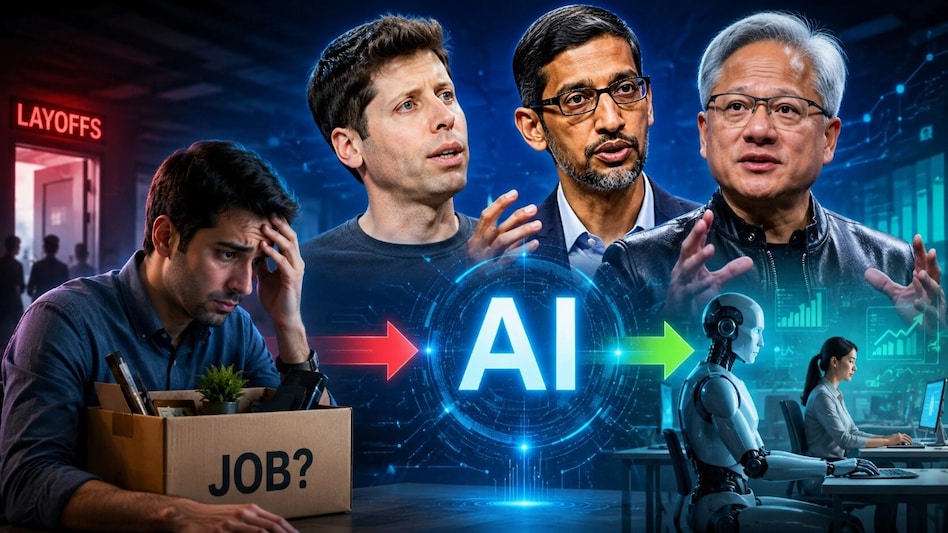
Google's AI Investments Lead to Unprecedented Cash Flow Loss
Google has revealed a staggering shift in its financial landscape, reporting a negative free cash flow of $5.9 billion f...
Business Insider | Jul 22, 2026, 23:40