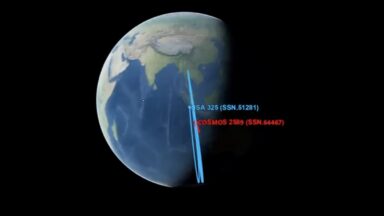
Three’s a party: US, China, and now Russia are on the prowl in GEO
As global powers expand their presence in space, the competition for dominance in geosynchronous orbit (GEO) has intensified. The United States has long maintained a fleet of 'inspector' satellites designed to monitor the activities of other spacecraft at high altitudes. This initiative has been in place for over a decade, allowing the military to gather intelligence by getting close to foreign satellites and capturing detailed imagery. China has entered the arena as well, launching its own satellites for similar surveillance missions since 2018. Recently, Russia has made its move by deploying a suspected inspector satellite into GEO, marking its official entry into this critical domain. This escalating competition promises to reshape the landscape of space surveillance. Geosynchronous orbit, positioned approximately 22,000 miles (36,000 kilometers) above the equator, is unique in that satellites in this orbit match the Earth's rotation, allowing them to remain fixed over a specific location. This makes GEO particularly valuable for both commercial and military applications, as satellites can provide extensive communication services over prolonged periods. Historically, Russia's activities in GEO have centered on intercepting foreign communications. By deploying satellites such as Olymp or Luch, Russia has been attempting to linger near Western satellites, eavesdropping on transmissions and potentially disrupting secure communications used by NATO and US military forces. The modern focus, however, has shifted towards reconnaissance and surveillance of satellite capabilities. Military and intelligence agencies are increasingly interested in understanding the positioning, appearance, and functionalities of foreign satellites. The US military's Geosynchronous Space Situational Awareness Program (GSSAP) has been operational since 2014, utilizing maneuverable satellites to gather intelligence by closely observing Chinese and Russian counterparts, enhancing their situational awareness in this strategic orbital zone.
The Future of Work: Executives Weigh In on AI's Impact on Gen Z Careers
As generative artificial intelligence continues to rise, uncertainty looms for the incoming Gen Z workforce. Leaders fro...
Business Insider | Jul 26, 2026, 10:15Finland Unveils World's Largest Sand Battery to Tackle Renewable Energy Challenges
In a groundbreaking move to address the critical issue of renewable energy intermittency, a small town in southern Finla...
CNBC | Jul 25, 2026, 05:35
Linux Creator Challenges Developers: Embrace AI or Fork Off!
In a recent discussion surrounding the use of AI in software development, Linus Torvalds, the founder of Linux, voiced h...
Business Insider | Jul 26, 2026, 13:10Warner Bros. Takes Legal Action Against Amazon Over Executive Poaching Allegations
Warner Bros. Discovery has initiated legal proceedings against Amazon, accusing the tech giant of unlawful interference ...
TechCrunch | Jul 25, 2026, 21:25
Market Turbulence: Four Key Factors Impacting Stocks This Week
This past week has been challenging for the stock market, driven by several significant forces that have created turbule...
CNBC | Jul 25, 2026, 20:05