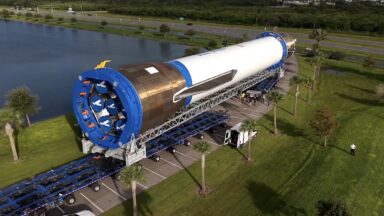
Rocket Report: Bezos’ firm will package satellites for launch; Starship on deck
Greetings to our latest edition of the Rocket Report! Despite the ongoing federal government shutdown, the space industry remains largely unaffected. Military space missions continue without disruption, and NASA is actively preparing for the Artemis II mission, slated for a lunar flyby early next year from the Kennedy Space Center in Florida. The International Space Station continues its operations with a full crew of seven in low-Earth orbit, and NASA's various spacecraft engaged in cosmic exploration are still operational. It’s crucial to note, however, that the federal shutdown has significant implications for military personnel and federal employees, who are on the verge of missing their first paychecks unless a resolution is reached in Congress. In the latest developments, a concerning report highlights the issue of space debris, particularly focusing on the 50 most hazardous objects currently in low-Earth orbit. Alarmingly, a significant portion of this debris consists of defunct rockets, many of which date back over 25 years. Darren McKnight, the lead author of a recent paper presented at the International Astronautical Congress in Sydney, emphasized that the majority of these problematic objects were launched before the year 2000. He revealed that 76% of the top 50 items were deposited last century, with a staggering 88% being rocket bodies. Another pressing concern arises from activities in low-Earth orbit, particularly those involving China. Since the beginning of 2024, there have been 26 abandoned rocket bodies left in orbit, with China responsible for 21 of them. The overall statistics are troubling: Russia and the Soviet Union top the list with 34 objects in the top 50, followed by China with 10, the United States with three, Europe with two, and Japan with one. Russia's SL-16 and SL-8 rockets are notably the worst offenders, occupying 30 slots in the top 50. The potential dangers of this debris cannot be overstated. An impact with even a relatively small object traveling at orbital speeds could generate vast amounts of additional debris, setting off a chain reaction of collisions in a scenario known as Kessler Syndrome, which threatens to worsen the clutter in low-Earth orbit.
Yang Zhilin: The Rising Star of China's AI Landscape with Kimi K3
In the rapidly evolving world of artificial intelligence, one name is making headlines: Yang Zhilin. At just 34 years ol...
Business Insider | Jul 18, 2026, 16:10Earnings Season Kicks Off Amidst AI Buzz
As the earnings season begins, the spotlight has shifted dramatically towards artificial intelligence advancements, over...
CNBC | Jul 18, 2026, 16:45
India's Groundbreaking Leap in Precision Timing with White Rabbit Technology
In the realm of modern digital infrastructure, time stands as an unseen yet crucial component. Every mobile call, financ...
Business Today | Jul 19, 2026, 10:50
The Shift in Electric Vehicle Offerings: A Look at U.S. Discontinuations
The automotive landscape is undergoing a significant transformation as various companies announce the discontinuation of...
TechCrunch | Jul 18, 2026, 16:45
AI Takes on the Soccer Stakes: Who Will Win the Betting Game?
How do you evaluate the predictive prowess of artificial intelligence? Recently, the CTO of the startup Obside shared a ...
Business Insider | Jul 19, 2026, 10:15