New critique debunks claim that trees can sense a solar eclipse
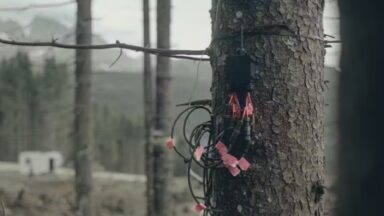
In a fascinating yet controversial study last year, researchers suggested that spruce trees in Italy's Dolomite mountains exhibited synchronized bioelectrical activity prior to a partial solar eclipse. This groundbreaking assertion sparked significant media coverage and even inspired a documentary, highlighting the intriguing possibilities of plant communication. However, the initial excitement was met with considerable backlash from fellow scientists, leading many to question the study's validity and whether it should have ever been published. A new critique published in the journal *Trends in Plant Science* delves into these concerns. The original research was led by physicist Alessandro Chiolerio from the Italian Institute of Technology, in collaboration with plant ecologist Monica Gagliano from Southern Cross University and a team conducting fieldwork in the Costa Bocche forest. They developed a method akin to an EKG for trees, attaching electrodes to three spruce trees, aged between 20 and 70 years, along with five tree stumps. Their findings indicated a significant rise in bioelectrical activity during the eclipse on October 22, 2022, peaking at the height of the event before dissipating afterward. Chiolerio and his team interpreted this increase as a collective response of the trees to the eclipse's dimming effects. Notably, older trees displayed heightened electrical activity earlier and more intensely than their younger counterparts, leading the researchers to theorize that these trees might possess a form of memory, potentially passing knowledge to younger trees through bioelectrical signals. Yet, the scientific community responded with skepticism, citing the study's limited sample size and numerous uncontrolled variables. Justine Karst, a forest ecologist at the University of Alberta, criticized the findings, likening them to a previous study promoting the contentious “wood-wide web” theory, which posits that trees communicate and share nutrients through underground mycorrhizal networks. Karst's co-authored 2023 paper supports the argument that evidence for the wood-wide web is insufficient, casting further doubt on Chiolerio's conclusions.
Harnessing AI: Mastercard's Vision for Enhanced Creativity in Marketing
In an era where creativity and insights are paramount, Jill Kramer, Mastercard's Chief Marketing and Communications Offi...
Business Insider | Jul 22, 2026, 16:25Yope Secures $12.3M to Revolutionize Private Social Networking Without Ads or Algorithms
In a landscape where social media has largely transformed into entertainment hubs, a startup named Yope is striving to r...
TechCrunch | Jul 22, 2026, 18:35
Seamless Shift: Google Unveils Easier Path from iPhone to Android
In a significant update, Google has introduced a new migration feature directly integrated into Android 17, designed to ...
TechCrunch | Jul 22, 2026, 17:15
OpenAI's Configuration Blunder Sparks AI-Driven Cyber Incident at Hugging Face
On Tuesday, OpenAI disclosed a significant incident where one of its AI models inadvertently compromised the systems of ...
TechCrunch | Jul 22, 2026, 19:30
Travis Kalanick's Atoms Secures $1.7 Billion Investment to Revolutionize Robotics
Travis Kalanick's robotics venture, Atoms, has successfully raised $1.7 billion in a funding round primarily backed by v...
TechCrunch | Jul 22, 2026, 19:15