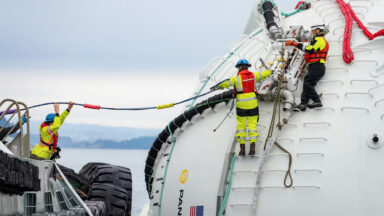
Silicon Valley bets on floating AI data centers powered by ocean waves
In a groundbreaking shift, Silicon Valley investors, including Palantir co-founder Peter Thiel, are channeling hundreds of millions of dollars into the development of AI data centers that harness the power of ocean waves. This innovative approach comes in response to the increasing challenges tech companies face when establishing AI data centers on land. Recently, a new funding round raised $140 million for the startup Panthalassa, which is focused on completing a pilot manufacturing facility near Portland, Oregon. This investment aims to accelerate the deployment of floating 'nodes' designed to generate electrical power from wave energy. Unlike traditional data centers that rely on land-based renewable energy, these floating nodes are intended to directly power onboard AI chips, transmitting output data to clients worldwide via satellite. Benjamin Lee, a computer architect and engineer at the University of Pennsylvania, highlighted the ingenuity of Panthalassa’s approach. "This concept turns an energy transmission dilemma into a data transmission challenge," he explained. To execute AI computations at sea, models must be transferred to these ocean-based nodes that respond to queries and prompts. Each node is designed as a large steel sphere that floats on the water, featuring a tube that extends vertically beneath the surface. The natural wave motion forces water up through the tube into a pressurized chamber. This process enables the water to spin a turbine generator, which in turn produces renewable energy for the onboard AI chips. Furthermore, Panthalassa asserts that the surrounding ocean water will also provide cooling for the AI chips, presenting a significant advantage over conventional data centers. Lee noted, "Ocean-based computing could offer substantial cooling benefits due to the lower ambient temperatures, while land-based facilities often consume considerable electricity and freshwater for cooling."
Crisis Averted: Power Line Failure Highlights Urgent Need for Data Center Resilience
A power line failure near Washington, DC, recently showcased a significant challenge faced by the electrical grid due to...
TechCrunch | Jul 25, 2026, 13:50
OpenAI's Micro Keypad: A Novelty for Coders or Just a Confounding Gadget?
Last week, OpenAI made its debut in the hardware landscape with the launch of Micro, a stylish keypad designed to integr...
TechCrunch | Jul 25, 2026, 24:40
The Shift in Human Cognition: Embracing AI as a Collaborative Tool
As technology continues to evolve, a notable shift is occurring in the relationship between humans and artificial intell...
Business Insider | Jul 25, 2026, 09:50SpaceX Successfully Tests Starship Rocket, Launching New Era of Space Exploration
On Friday evening, SpaceX executed a significant milestone by launching its colossal Starship rocket from its facility i...
CNBC | Jul 25, 2026, 24:10
Elon Musk Faces Major Setbacks as Tesla and SpaceX See Significant Stock Declines
It has been a challenging week for Elon Musk, as both Tesla and SpaceX experienced substantial stock declines. Tesla sha...
CNBC | Jul 24, 2026, 20:40