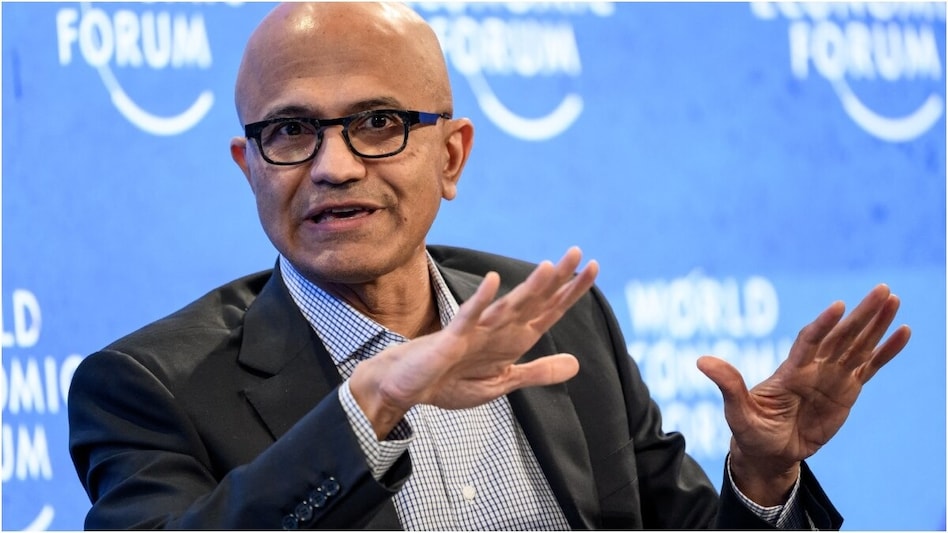
‘Zero-sum thinking has no...’: Satya Nadella’s AI blueprint for next tech era; Musk’s reaction sparks buzz
In a bold declaration, Microsoft CEO Satya Nadella has shared an expansive vision for the future of artificial intelligence, emphasizing that AI platforms should prioritize user empowerment over corporate enrichment. His insights, shared on X (formerly known as Twitter), reference a pivotal idea from Bill Gates: "A platform is when the economic value of everybody that uses it exceeds the value of the company that creates it." Nadella believes this principle should be the guiding light for the next phase of AI development. Nadella envisions a future where businesses of all sizes can cultivate their own capabilities without sacrificing their core values to a few dominant tech giants. His post ignited significant discussion online, particularly after Elon Musk's enigmatic emoji response, which fueled speculation across various social media platforms. Reiterating Gates' definition, Nadella emphasized the need for AI to serve as a positive-sum force, promoting opportunities rather than consolidating them. He highlighted Microsoft's collaborations with OpenAI, Nvidia, and AMD as examples of ecosystems that foster mutual innovation. According to Nadella, these partnerships have influenced the creation of Microsoft's newly unveiled AI superfactory, designed in collaboration with OpenAI and leveraging decades of supercomputer advancements. This facility aims to provide foundational infrastructure to help businesses train and deploy their own AI models, rather than just advancing Microsoft's goals. Nadella pointed out that the AI stack now incorporates both Nvidia and AMD technologies, offering developers a wider choice and preventing vendor lock-in—an embodiment of the platform ideology he champions. He illustrated how AI is expanding rather than contracting markets, citing GitHub Copilot as a tool that enhances the software development landscape by empowering more individuals to code and allowing existing developers to increase their productivity. However, Nadella stressed that the true effectiveness of AI will be assessed beyond the tech realm. He noted that significant advancements in areas like drug discovery, supply chain efficiency, advanced manufacturing, and personalized education will serve as true indicators of AI’s impact. He cited a scenario where a pharmaceutical company could bring a new therapy to market in one year instead of twelve as a benchmark for success. Cautioning against potentially harmful partnerships, Nadella urged companies to safeguard their data, independence, and long-term viability. He warned against adopting “zero-sum thinking” and encouraged businesses to be mindful of partnerships that might lead to extractive practices as AI becomes increasingly integrated across various sectors. In his concluding remarks, he asserted that the success of the AI era should not be measured by soaring tech valuations, but by the tangible improvements experienced by industries such as healthcare, agriculture, manufacturing, and education—a transformation that must uplift entire sectors rather than diminish them.
Microsoft Faces Global Service Disruption Amid Major Outage
Microsoft is gradually recovering from a significant outage that lasted an entire day, impacting numerous systems due to...
TechCrunch | Nov 13, 2026, 13:35
CFTC Chair Highlights Crypto Exchanges' Shift Towards New Regulations
Michael Selig, Chairman of the Commodity Futures Trading Commission (CFTC), recently shared insights on the growing inte...
CNBC | Nov 13, 2026, 13:55
OpenAI Unveils ChatGPT Wallet: Your New AI Shopping Assistant
In an exciting development, OpenAI has introduced a groundbreaking wallet feature for ChatGPT that allows its AI agents,...
TechCrunch | Nov 13, 2026, 16:20
Nvidia's Export Ban Dilemma: China's AI Models Thrive Amid Smuggling Allegations
Recent research reveals that leading Chinese companies have been training their advanced AI models using Nvidia chips, w...
TechCrunch | Nov 13, 2026, 19:05
Nvidia's Leadership Search Underway Amid Controversy Surrounding Former CEO
Nvidia's board has announced that they are currently in the process of selecting a search firm to aid in finding a new C...
CNBC | Nov 13, 2026, 19:55