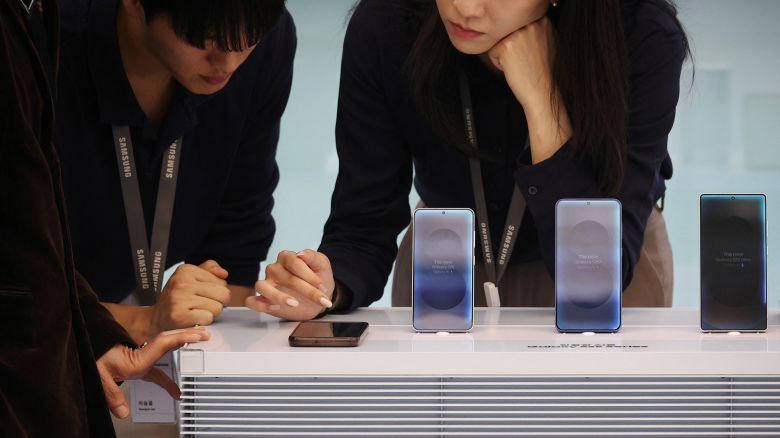
Samsung profit tumbles as it struggles to catch up in the AI chip race
Samsung Electronics, once a leader in the global semiconductor industry, is currently grappling with significant challenges in the fast-evolving AI chip market. After failing to seize early opportunities presented by the AI boom, the company has seen its market share diminish, raising concerns among experts regarding its future. In the second quarter, Samsung reported a staggering 55% drop in operating profit, falling to 4.7 trillion won ($3.4 billion) from 10.4 trillion won ($7.5 billion) the previous year. While revenue saw a slight increase, the company's chip division, which traditionally generated two-thirds of its total profit, experienced a nearly 94% decline in operating profit compared to the same timeframe a year ago. This downturn has been attributed to inventory adjustments, low utilization rates in contract chipmaking, and the ongoing impact of U.S. export restrictions on advanced AI chips to China, a crucial market for Samsung. The disappointing earnings report has reignited fears about the tech giant's stability. Earlier this month, Samsung had already warned investors of its bleak performance. However, the announcement of a $16.5 billion partnership with Tesla to produce new chips could provide a much-needed boost to Samsung's outlook. The company is now focused on meeting the rising demand for AI-driven products and enhancing its competitive edge in advanced semiconductors for the latter half of the year. Samsung has been facing considerable obstacles in both memory and logic chip markets. Once a dominant player in memory chip manufacturing, it has lost ground to competitors like SK Hynix and Micron Technology, particularly in the burgeoning high-bandwidth memory (HBM) sector. These chips are critical for AI processors developed by firms such as Nvidia and AMD. In the logic semiconductor space, Samsung lags significantly behind TSMC, which commands a 68% market share compared to just 8% for Samsung, as reported by TrendForce. Sanjeev Rana, head of Korea research at CLSA, pointed out that Samsung's struggles stem from a series of missteps, including a delayed recognition of the AI demand surge and misguided product bets. Consequently, the company has missed opportunities to supply Nvidia, which accounted for nearly 80% of global HBM demand last year. Despite securing orders from AMD and Broadcom, Samsung's rivals have already begun delivering advanced memory chips to the market. Furthermore, the company's logic chip segment is under pressure, with underutilized facilities resulting from an inability to secure significant orders for its advanced chips. CLSA estimated that Samsung’s contract chipmaking unit incurred an operating loss of 5.6 trillion won ($4.1 billion) last year, with projections indicating that this loss could rise to 6.6 trillion won ($4.8 billion) this year. U.S. restrictions on chip sales to China have compounded revenue challenges, as shipments to Chinese clients have been stalled pending regulatory reviews. However, with some chips now cleared for shipment, analysts believe the second quarter was the most severely impacted period. The recent deal with Tesla offers a potential lifeline for Samsung. CEO Elon Musk announced that the electric vehicle manufacturer has enlisted Samsung to produce its next-generation AI6 chip, which will be crucial for self-driving cars and humanoid robots. This partnership is expected to enhance the utilization of Samsung's new manufacturing facility in Texas, which had its operational start postponed to 2026 due to customer acquisition struggles. Industry experts view this collaboration as a significant development that could improve Samsung's profitability and validate its advanced chip production capabilities. Although mass production is not set to commence until 2027, the deal is seen as a positive signal for market sentiment and a testament to the company's restructuring efforts over the past year. Analysts are optimistic that conditions will improve for Samsung in the latter half of the year.
Market Turbulence: U.S.-Iran Tensions and Tech Giants Face Investor Scrutiny
In a day marked by heightened geopolitical tensions and mixed corporate earnings, investors are bracing for a turbulent ...
CNBC | Jul 08, 2026, 12:25
Tech Veteran Kevin Weil Joins Stoke Space Board as Company Aims for Rocket Innovation
Kevin Weil, an esteemed figure in the tech industry with experience at companies such as Twitter, Meta, Planet Labs, and...
TechCrunch | Jul 08, 2026, 12:35
Blue Origin Soars to $130 Billion Valuation in Historic Fundraising Effort
Blue Origin, the aerospace venture founded by Jeff Bezos, is embarking on a significant fundraising journey, aiming to s...
CNBC | Jul 08, 2026, 12:45
AI Investments Stabilize Global Economy Amid Ongoing Conflicts, Reports IMF
The International Monetary Fund (IMF) has highlighted that while ongoing conflicts in the Middle East exert pressure on ...
Business Today | Jul 08, 2026, 13:15
AI Titans Clash: OpenAI Unveils GPT-5.6 as Musk Prepares to Launch Grok 4.5
OpenAI is set to introduce its most advanced AI model to date, the GPT-5.6 family, with a public rollout scheduled for T...
Business Insider | Jul 08, 2026, 11:00