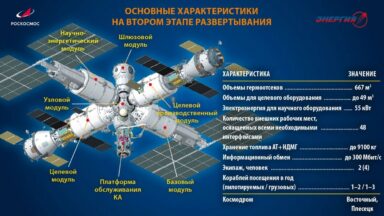
Russia is about to do the most Russia thing ever with its next space station
In a significant update to Russia's human spaceflight ambitions, officials have revealed a shift in their plans for the Russian Orbital Station (ROS). Previously touted as a new venture with a launch set for 2027 and operational by 2028, ROS is now set to incorporate elements from the existing Russian segment of the International Space Station (ISS). The station is envisioned to eventually consist of seven advanced modules, potentially including accommodations for space tourists. The design aims for the station to operate autonomously for extended periods, a testament to its sophisticated engineering. Critically, the ROS is planned to orbit at an altitude of approximately 400 kilometers in a polar orbit, which allows it to pass over all of Russia, enhancing national pride as cosmonauts can launch from the new Vostochny Cosmodrome rather than Kazakhstan. The recent announcement by Oleg Orlov, the director of the Institute of Biomedical Problems of the Russian Academy of Sciences, indicates a strategic pivot. Orlov stated that the Scientific and Technical Council of Roscosmos has approved the integration of the existing ISS modules into ROS. This revelation aligns with earlier comments from First Deputy Prime Minister Denis Manturov regarding the station's orbital inclination, now confirmed at 51.6 degrees, matching that of the ISS. By 2030, the plan entails a notable separation of the Russian segment from the U.S. side of the ISS, with a SpaceX Dragon spacecraft tasked with safely returning the aging American modules to Earth. This transition marks a pivotal moment in Russia's space exploration narrative, as it positions itself more independently in the realm of human spaceflight.
Prentis: Ambitious New AI Lab Eyes $100 Million Funding with Innovative Automation Goals
Prentis, a cutting-edge AI research laboratory co-founded by Ritankar Das, Reid Hoffman, and Marc Pincus, is currently i...
TechCrunch | Jul 24, 2026, 22:45
The Shift in Human Cognition: Embracing AI as a Collaborative Tool
As technology continues to evolve, a notable shift is occurring in the relationship between humans and artificial intell...
Business Insider | Jul 25, 2026, 09:50Unlocking the Secrets of Quantum Gravity: Can AI Help Physics Make a Leap?
The realm of scientific research is undergoing a profound transformation, fueled by the rapid advancements in artificial...
Business Today | Jul 25, 2026, 24:30
Waymo to Launch Standalone App, Ending Exclusivity with Uber in Major Cities
For the past three years, Uber and Waymo, the autonomous vehicle division of Alphabet, have collaborated to provide driv...
CNBC | Jul 24, 2026, 21:55
The Rise of AI Distillation: A Controversial Technique Sparks Debate in Tech and Government
In recent discussions, a once-obscure topic in artificial intelligence has surged to the forefront of debates among tech...
CNBC | Jul 25, 2026, 12:15