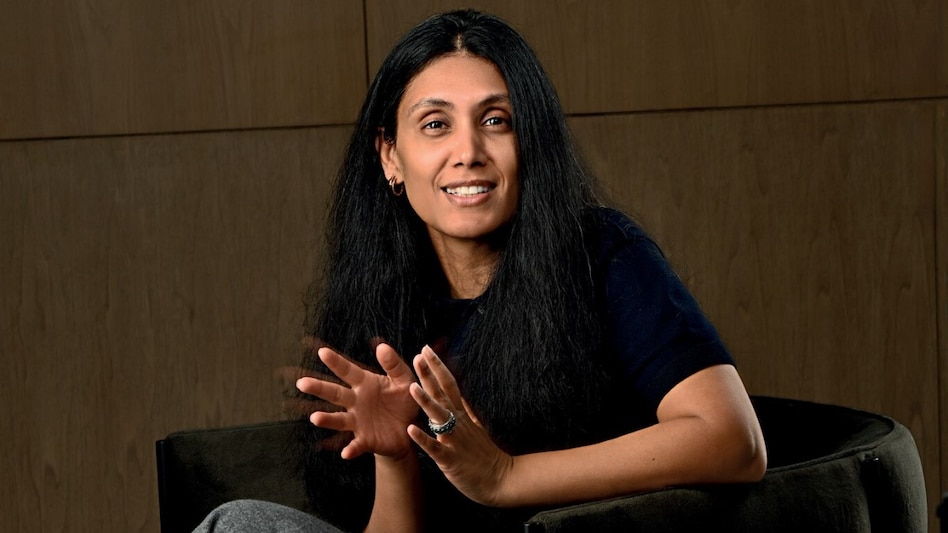
‘Hum of AI will define this decade’: Roshni Nadar urges India to move from tech services to IP nation
During the India AI Impact Summit 2026, Roshni Nadar, the Chairperson of HCL Technologies, emphasized the need for India to shift its approach to artificial intelligence. She argued for a transition from a focus on scale-driven services to an emphasis on creating intellectual property (IP). Nadar steered the discussion away from mere financial projections, urging leaders to concentrate on the implications and responsibilities that come with this pivotal technological era. Reflecting on India's digital evolution, she noted that we are now in a period characterized by the 'invisible hum of neural networks,' which are subtly transforming our society. Artificial intelligence, according to Nadar, has become an omnipresent entity in our lives, serving as a guide and companion rather than just a tool. She described AI as a 'structural shift' that commoditizes knowledge itself, asserting that in this new landscape, competitive advantages will no longer stem from raw computing power but from the clarity of thought. Nadar highlighted that India must transition from being solely a tech services nation to an IP-driven one. She pointed out that while services require significant effort to scale, intellectual property has the potential to grow infinitely. This shift, she argued, will create value for those who develop and own platforms and products in the AI economy. To facilitate this transformation, she proposed three key priorities: prioritizing IP-led value creation over scale-led growth, transitioning from technology adoption to technology creation, and viewing computation as a digital public infrastructure to ensure equitable access for startups, universities, and enterprises. At HCLTech, Nadar stated that the company is evolving its model to combine software products, intelligent agents, and human expertise, alongside launching new AI-driven service lines like 'AL Factory' and 'Physical AI.' Addressing the governance of AI, Nadar stressed that the true challenge lies not in AI's capabilities but in how responsibly it is implemented. She highlighted the importance of responsible AI as a foundational principle, stating that without control and trust, speed and scale are meaningless. Nadar used a T20 cricket analogy to illustrate her point, comparing AI to a powerful hitter who can achieve what previously required an entire team. Concluding her remarks, she stated, 'The hum of AI will define this decade,' while emphasizing the long-lasting impact of leadership that is responsible, wise, and clear in shaping the future of technology.
Revolutionizing Code Management: Anthropic Unveils Claude Ship
Anthropic is taking a significant leap in the realm of software development by introducing Claude Ship, a powerful suite...
TechCrunch | Nov 23, 2026, 22:10
Political Backlash Follows Jensen Huang's Surprising Return to Nvidia
Jensen Huang, the CEO and co-founder of Nvidia, has made a startling comeback after being ousted just over a week ago du...
TechCrunch | Nov 23, 2026, 19:40
Saudi Engineer Faces Legal Battle Over Alleged Espionage Using AI Tech
A Saudi engineer employed by OpenAI, Abdulrahman Alfozan, is at the center of a legal dispute as prosecutors allege he u...
Business Insider | Nov 23, 2026, 23:50Staggering Recovery Rates Highlight Digital Payment Fraud Challenges
The battle against digital payment fraud continues to be an uphill struggle for consumers, with official data revealing ...
Business Today | Nov 24, 2026, 09:30
Nvidia's CEO Return Reshapes AI Landscape, Puts Anthropic on Edge
The return of Jensen Huang as CEO of Nvidia has sent ripples through the AI market, causing most AI stocks to rally, yet...
Business Insider | Nov 23, 2026, 18:25