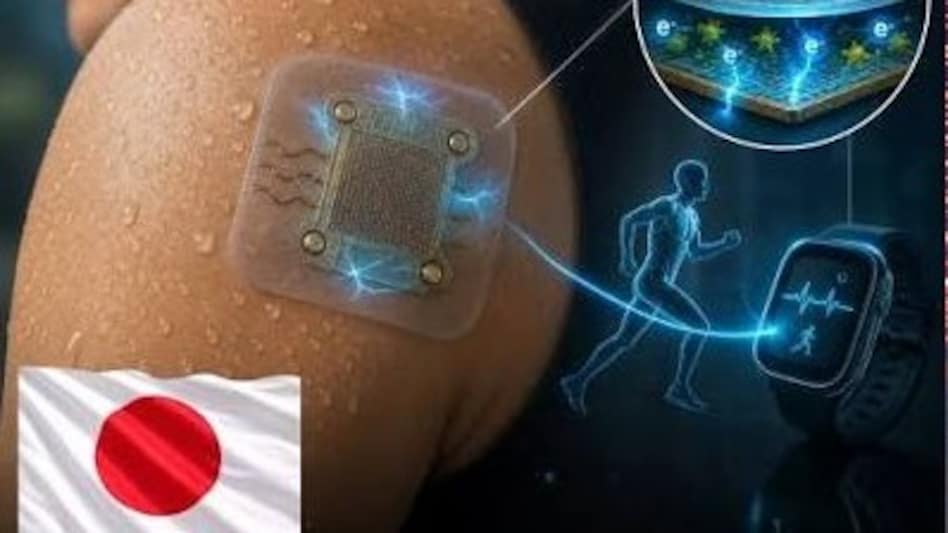
Powered by sweat: Why Japan's latest innovation could reshape wearable tech
Imagine a wearable health device that never needs a charge, powered solely by your body's sweat. This vision is closer to realization thanks to groundbreaking research from the Tokyo University of Science, which has introduced a flexible biofuel cell that harnesses electricity from human perspiration. While this innovation won't power your smartphone just yet, it holds promise for self-sustaining health monitors that utilize the body's natural chemistry. The newly developed device is a thin and flexible biofuel cell that converts lactate, a compound found in sweat, into electricity. It is specifically designed for low-energy wearable electronics, such as health-monitoring patches and fitness sensors, rather than high-consumption gadgets. So, how does this remarkable device function? It employs enzymes that react with the lactate in sweat, resulting in a chemical reaction that releases electrons and generates a small electrical current capable of powering tiny electronic components. Unlike traditional batteries, this biofuel cell activates only when sweat is present, making it ideal for wearables used during exercise or ongoing health monitoring. What sets this innovation apart from previous sweat-powered biofuel cells is its focus on practicality in manufacturing. The research team has developed a water-based enzyme ink that can be screen-printed onto flexible materials, simplifying production and potentially reducing costs. This design allows the patch to flex and move with the skin, increasing comfort for users. In terms of power generation, the biofuel cell achieves a peak power density of approximately 165 microwatts per square centimeter, operating at around 0.63 volts. This output is adequate for low-energy devices such as biosensors and sweat-monitoring patches, but it falls short of powering smartphones, laptops, or other high-energy devices. The potential applications for this technology are vast. Researchers envision a variety of wearable healthcare and fitness products that could operate without the need for frequent battery replacements or recharges. However, it's important to note that the technology is still in the research phase and not yet available for commercial use. Before this biofuel cell can be used in consumer products, researchers need to enhance its long-term durability, enzyme stability, and performance in real-world scenarios. If development progresses successfully, practical applications could emerge later in this decade. Ultimately, this research's importance lies not just in generating electricity from sweat, which has been demonstrated before, but in streamlining the manufacturing process. If successful, it could fast-track the production of self-powered wearables that continuously monitor health without the reliance on conventional batteries.
Meta's Ambitious $50 Billion Data Center Expansion in Louisiana Set to Transform AI Landscape
Meta is significantly ramping up its Hyperion data center initiative in rural Louisiana, with the total investment proje...
CNBC | Jul 13, 2026, 09:45
China's GLM-5.2 AI Model: A Free Alternative with Room for Improvement
A new open-source AI model from China, GLM-5.2, is gaining attention for its capabilities in various tasks, drawing comp...
Business Insider | Jul 13, 2026, 08:15Prominent Figures Unite Against AI Job Displacement in Urgent Open Letter
A coalition of over 200 esteemed economists, industry leaders, and researchers, including more than a dozen Nobel laurea...
Business Insider | Jul 13, 2026, 13:10BSNL Unveils Rs 1.34 Lakh Satellite Phone: A Lifeline for Specialized Users
Bharat Sanchar Nigam Limited (BSNL) has introduced a satellite phone priced at Rs 1.34 lakh, specifically designed for i...
Business Today | Jul 13, 2026, 11:15
TSMC Sees Remarkable Revenue Growth Fueled by AI Demand
Taiwan Semiconductor Manufacturing Company (TSMC), the leading global contract chipmaker, announced a staggering 67.9% i...
CNBC | Jul 13, 2026, 05:55