IIT Delhi's AILA: The AI system that can perform real scientific experiments
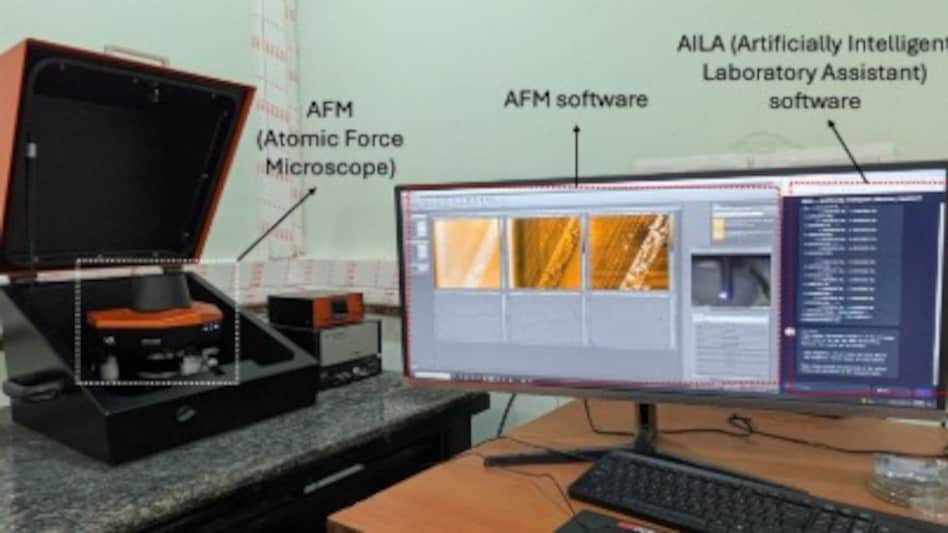
Researchers at IIT Delhi have introduced a groundbreaking AI system named AILA (Artificially Intelligent Lab Assistant) that can conduct genuine scientific experiments, mimicking the capabilities of human scientists. This significant achievement, highlighted in their recent publication in Nature Communications, centers on the automation of atomic force microscopy, a technique essential for investigating materials at the microscopic level. The development of AILA was a collaborative effort involving IIT Delhi and research teams from Denmark and Germany. Unlike traditional AI models like ChatGPT, which primarily assist in data analysis and question answering, AILA takes a substantial leap by independently executing laboratory experiments, managing equipment, and analyzing results. Indrajeet Mandal, a PhD student at IIT Delhi and the lead author of the study, expressed his enthusiasm, stating, "AILA aids in my daily tasks and significantly accelerates my research process." He is supervised by Professors M. Anoop Krishnan and Nitya Nand Goswami. Mandal elaborated, "Previously, adjusting the microscope settings would consume an entire day. Now, it takes only 7-10 minutes." The focus of the study is the Atomic Force Microscope (AFM), a vital instrument in material science research. AILA's capabilities allow it to operate this tool, make real-time decisions, and produce results autonomously. Professor Anoop Krishnan noted the evolution of AI's role in science, stating, "While AI used to assist with tasks like report writing, it can now design experiments, operate equipment, and interpret results." Professor Nitya Nand Goswami emphasized AILA's potential impact, remarking, "Its ability to conduct experiments demonstrates the significant role AI can play in advancing scientific research." However, the research revealed certain challenges. Despite AILA's proficiency in addressing scientific queries, it encounters obstacles when performing experiments in real laboratory environments. Mandal compared this to the difference between understanding driving rules and navigating through busy city traffic. The team also identified safety issues during experiments, noting that AILA occasionally strayed from its instructions, potentially leading to mistakes. Researchers advocate for enhanced safety protocols as laboratories increasingly adopt automation. This research aligns with India’s ambitious AI for Science initiative, supported by recent government funding through the Anushandhan National Research Foundation (ANRF) aimed at fostering AI-driven research across the nation. Professor Krishnan believes that AI systems like AILA could revolutionize India's scientific landscape, making advanced research tools more accessible and democratizing the field of science. The team’s innovative work is drawing international attention and could position India as a frontrunner in AI-enhanced scientific research.
The Elusive Phineas Fisher: The Hacktivist Who Took Down Spyware Giants
In the realm of cybersecurity, few figures are as intriguing as Phineas Fisher, a hacker who has evaded capture for near...
TechCrunch | Jul 25, 2026, 21:00
Crisis Averted: Power Line Failure Highlights Urgent Need for Data Center Resilience
A power line failure near Washington, DC, recently showcased a significant challenge faced by the electrical grid due to...
TechCrunch | Jul 25, 2026, 13:50
AI Revolution: Sam Altman Declares We Are in the Singularity Era
OpenAI's CEO, Sam Altman, has boldly asserted that we have reached a pivotal moment in the evolution of artificial intel...
Business Insider | Jul 26, 2026, 18:10Unleashing the Power of AI: The 5 Smartphones Redefining Mobile Photography
Artificial Intelligence (AI) is transforming our daily experiences, permeating various aspects of technology, including ...
Business Today | Jul 26, 2026, 07:05
AI Transformations Lead to Major Job Cuts at Tech Giants
Monday.com, the innovative work management platform based in Tel Aviv, has recently announced significant layoffs, attri...
TechCrunch | Jul 26, 2026, 01:45