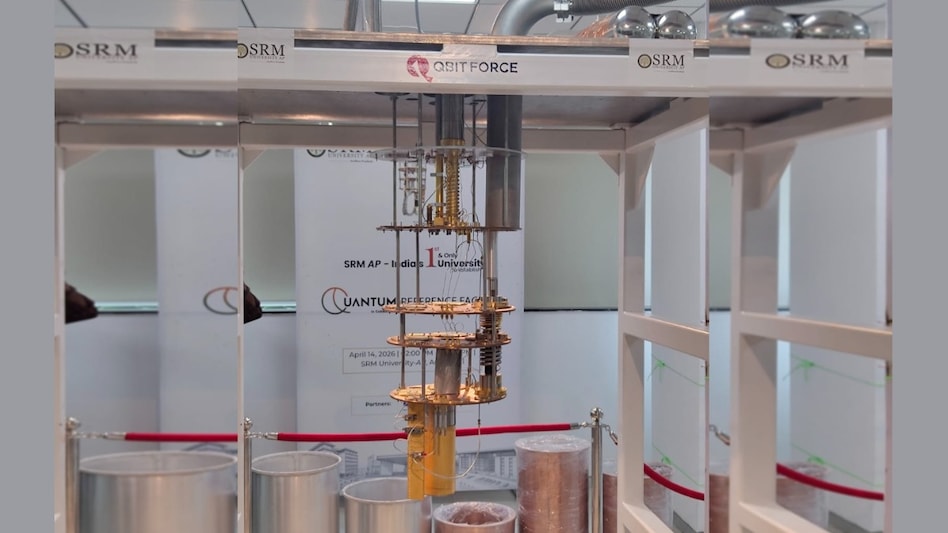
Inside India’s first open-access quantum test beds in Amaravati built at half the global cost
India has taken a significant leap in the quantum technology domain with the launch of its first open-access quantum computer test beds in Andhra Pradesh. Developed by QBit Force, these state-of-the-art facilities are located at SRM University in Amaravati and Medha Towers in Gannavaram, signifying a pivotal move towards establishing a robust domestic quantum hardware ecosystem. These test beds serve as controlled environments where quantum hardware can be tested, validated, and refined. Unlike traditional quantum laboratories around the globe, these facilities are designed to be open-access, allowing researchers, startups, and students to directly engage with the hardware. QBit Force CEO Venkata Subramanian emphasizes that the components were sourced from various Indian manufacturers, including TIFR and DRDO, creating a community-driven model. At the heart of this initiative is QU-414, a quantum characterization facility operated by Qubitech. This lab provides hands-on access to quantum hardware that was previously only available in a select few advanced labs worldwide. Unlike classical computers that process information using bits, quantum computers utilize qubits, which can exist in multiple states simultaneously, enabling them to solve complex problems more efficiently. However, this sensitivity to external disturbances necessitates that these systems operate at extremely low temperatures, approaching absolute zero. What distinguishes the Amaravati facilities is their open-hardware design. In contrast to typical quantum labs where systems are sealed, these facilities allow for the removal, replacement, and retesting of components. "QU-414 is more than just a testing facility; it also serves as a training hub," states Prudhvi Pinnaka, Founder and CEO of Qubitech. The team is committed to developing affordable revenue models to democratize access to quantum computer testing and validation. Cost efficiency has been a major consideration in establishing these facilities. Subramanian points out that local sourcing of components has successfully reduced the overall setup cost by nearly 50%, bringing it down to approximately Rs 15 crore. In comparison, similar infrastructure abroad could cost researchers up to 2,000 euros per day, which often restricts access for many startups and researchers. By providing this capability domestically, the test beds aim to enhance the accessibility of quantum hardware experimentation. The facility's focus extends beyond just quantum processors; it encompasses quantum hardware development, material characterization, and next-generation semiconductor research. Key areas of interest include cryogenics—critical for maintaining stable quantum states—and the integration of room-temperature electronics with ultra-cold hardware. In addition to the Medha Towers facility, the SRM University test bed is set to emphasize component testing and training, further opening doors for students and early-stage researchers to explore quantum technologies. The overarching goal is to cultivate a thriving local ecosystem around quantum technologies. According to CV Sridhar, director of the Andhra Pradesh State Quantum Mission, nearly 85% of quantum hardware components can already be produced domestically, with a roadmap in place for complete localization. The test beds represent a crucial element of the broader Amaravati Quantum Valley project, which envisions a dedicated research campus and the deployment of a 133-qubit quantum computer in collaboration with IBM, Tata Consultancy Services, and Larsen & Toubro. The state aims to create 100 quantum algorithms by 2028 across diverse sectors, including finance, logistics, energy, cybersecurity, and materials science, through a new Quantum Innovation Centre involving faculty and researchers from IITs.
Nvidia Unveils Vera CPU: A Bold Move to Disrupt the AI Server Market
Nvidia is making headlines once again, not just as a leader in graphics processing units (GPUs) but as a contender in th...
CNBC | Jul 21, 2026, 15:20
The Challenges of Open-Weight AI: Why China's Approach Is Struggling
The recent enthusiasm surrounding China's open-weight AI models is overshadowed by a stark reality: they are fundamental...
Business Insider | Jul 21, 2026, 17:50Amarillo's New AI Avatar: A Revolutionary Step Toward Enhanced City Services
In a groundbreaking move, Amarillo has unveiled a lifelike artificial intelligence that is set to transform access to ci...
Business Insider | Jul 21, 2026, 15:30Einride Expands Electric Trucking Vision with $38M Flipturn Acquisition
Swedish company Einride, known for its electric and autonomous trucking solutions, has made a significant move by acquir...
TechCrunch | Jul 21, 2026, 19:25
Instagram Introduces New Feature: Change Music on Old Posts Effortlessly
In a significant update announced on Tuesday, Instagram has unveiled a feature that allows users to change the music in ...
TechCrunch | Jul 21, 2026, 16:20