Building ordered polymers with metal
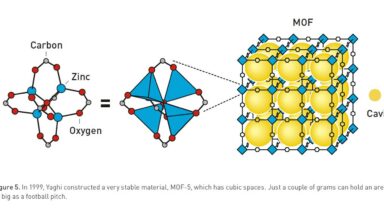
Polymers, the essential materials surrounding us, have typically been chaotic assemblages of intertwined atomic chains. However, since the early 1990s, chemists have pioneered methods to create polymers with meticulously defined structures, known as metal-organic frameworks (MOFs). These innovative frameworks possess unique chemical characteristics, including large pores that facilitate gas filtration and storage, as well as catalytic centers embedded within the polymer itself. In a recent announcement, the Nobel Prize Committee recognized the groundbreaking contributions of three scientists in the field of MOFs. Richard Robson was awarded for his pivotal demonstration of the first MOF, while Susumu Kitagawa and Omar Yaghi were honored for their efforts in fully realizing the potential of these structures. Traditionally, polymers are constructed from individual molecules linked by flexible bonds, resulting in a convoluted arrangement once formed into everyday items like plastic bags or bicycle tires. While some control over the polymer's properties can be achieved by adjusting bulk characteristics or selecting different base molecules, the chemistry options have been limited. The introduction of MOFs changes that paradigm. The metal components in these frameworks function as central hubs, allowing for the precise arrangement of rigid organic molecules that extend outward in various directions. Due to the nature of metal orbitals, each metal can bond with a specific number of organic molecules, creating fixed angles between those bonds. By carefully selecting the metal involved, researchers can engineer distinct three-dimensional structures, alternating between metals and organic components, thus opening new avenues for material science.
Agility Robotics Expands Operations Near Tesla, Aiming for Humanoid Robot Leadership
Agility Robotics is set to launch a substantial 60,000-square-foot facility in Fremont, California, strategically locate...
TechCrunch | Jul 17, 2026, 20:35
The Rise of AI Transcription: A New Era of Consent and Privacy
In a thought-provoking move, venture capitalist Jeremy Levine has taken a stand against the pervasive nature of AI trans...
TechCrunch | Jul 17, 2026, 21:45
Valar Atomics Eyes $6 Billion Valuation with New Funding Talks for Modular Nuclear Reactors
Valar Atomics, an innovative startup focused on developing small modular nuclear reactors (SMRs), is currently negotiati...
TechCrunch | Jul 17, 2026, 19:45
Luxury Meets AI: Inside Vertu's Premium Smartphone Experience
In the competitive landscape of smartphones, artificial intelligence has emerged as a key selling point. However, Vertu,...
TechCrunch | Jul 17, 2026, 23:25
Anthropic Explores Major Computing Partnership with Meta
Anthropic is reportedly in early discussions with Meta to secure a lease for computing power, as confirmed by a source f...
CNBC | Jul 17, 2026, 16:55