DeepMind’s robotic ballet: An AI for coordinating manufacturing robots
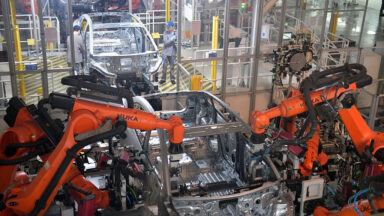
In today's world, robots play a crucial role in manufacturing, operating with precision as they move along conveyor belts in a well-orchestrated ballet of synchronized actions. Traditionally, programming these movements has been a labor-intensive task, often consuming hundreds to thousands of hours. Enter RoboBallet, an innovative AI system developed by Google’s DeepMind team, designed to empower manufacturing robots to autonomously determine their tasks. The challenge of directing these robots efficiently involves complex task allocation and scheduling—essentially deciding which robot should perform which task and in what sequence. This intricate process is akin to a more complex version of the famous traveling salesman problem. Additionally, ensuring that multiple robotic arms can operate without colliding with each other or surrounding equipment adds another layer of complexity. The team at DeepMind is addressing this trifecta of computational challenges: task allocation, scheduling, and motion planning. Matthew Lai, a research engineer at DeepMind, explains, “While there are existing tools for automating motion planning, task allocation and scheduling still require manual intervention. Our goal was to integrate all three aspects into a cohesive solution.” The team began by simulating environments known as work cells, where groups of robots execute their tasks on a designated product. In these work cells, a workpiece—specifically, a construction made of aluminum struts—was positioned on a table surrounded by up to eight Franka Panda robotic arms, each capable of seven degrees of freedom. These robots were tasked with completing as many as 40 different operations on the workpiece, with precision requirements that demanded the robotic arm's end effector to be within 2.5 centimeters of the target spot on a strut, approaching from the correct angle and holding steady for a brief moment to simulate actual work being done.
OnePlus Poised to Withdraw from US and European Markets, Focus on India Remains
Recent reports indicate that OnePlus, the Chinese smartphone giant, may soon cease its operations in the United States a...
Business Today | Jul 14, 2026, 07:25
Anthropic Unveils Localized Pricing for Claude AI in India
Anthropic has officially launched localized pricing for its Claude AI platform in India, enabling users on the Pro plan ...
Business Today | Jul 14, 2026, 06:35
Shenzhen's Rise: The New Epicenter of Global Tech Manufacturing
Greetings from Beijing! In the latest edition of The China Connection, we delve into the dynamic relationship between U....
CNBC | Jul 13, 2026, 23:15
Coursera Launches Ollie: A New AI-Powered Learning App Inspired by Social Media
Coursera has introduced Ollie, an innovative AI-driven mobile application designed to enhance the learning experience by...
Business Today | Jul 14, 2026, 09:40
OpenAI's Ambitious Hardware Plans Stalled by Legal Clash with Apple
OpenAI is reportedly venturing into the consumer electronics market with a product intended to compete with Apple's iPho...
Business Today | Jul 14, 2026, 10:10