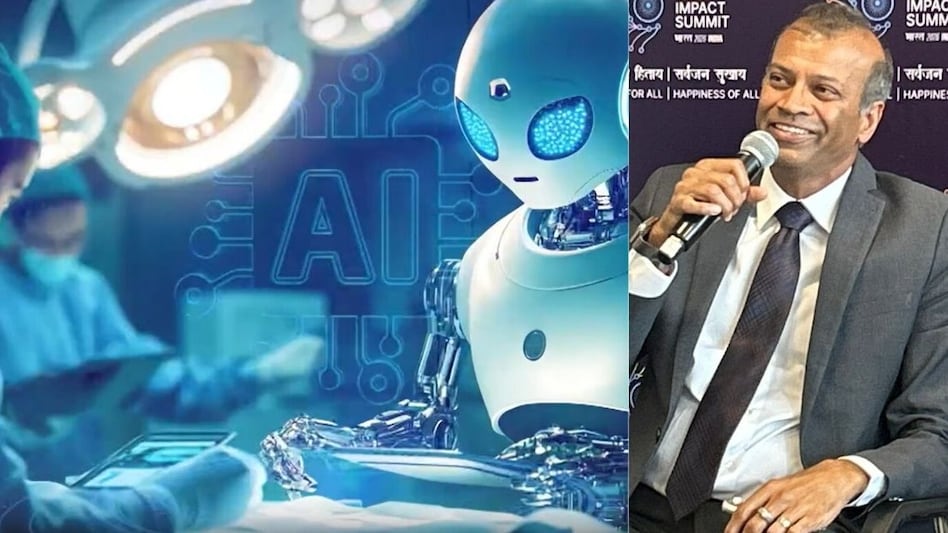
India AI Impact Summit 2026: 'AI won't cut healthcare jobs,' Stanford professor says it could create 150 million roles
At the India AI Impact Summit 2026, a prominent Stanford University professor shared a transformative vision for the future of healthcare employment in India, suggesting that artificial intelligence (AI) could lead to the creation of over 150 million jobs rather than eliminating them. Dr. Anurag Mairal, an Adjunct Professor of Medicine at Stanford, emphasized that the integration of AI is about reimagining care delivery, particularly in a country where a significant portion of the population still lacks adequate healthcare access. "Currently, over 8 billion people inhabit the planet, and about 5 billion do not have meaningful access to healthcare. Our existing model has shifted toward sick-care, with major institutions like AIIMS and Stanford serving as the primary care providers for many. However, the majority of people reside in homes, communities, and smaller towns," he stated during a panel discussion. Dr. Mairal called for a reconfiguration of healthcare systems to bring services closer to patients, making them more affordable. He warned that the current trajectory would lead to rising healthcare costs, urging the need for a health system that supports a healthy and productive population by 2047, aligning with India’s vision of becoming a developed nation. Instead of fearing job loss due to AI, Mairal argued that the healthcare sector will need a larger workforce as services expand into underserved areas. "In the U.S., about 15% of the population is involved in healthcare. If we apply that to India’s 1.4 billion people, we could see the necessity for over 150 million jobs to cater to their health needs as the population ages and care moves into smaller communities," he explained. He also highlighted the emergence of new roles, such as care navigators for high-risk patients, which currently do not exist but will be essential as AI-driven care models grow. "This shift will ultimately create new job opportunities, and many students will likely find careers in these new roles," he noted. Mairal believes that AI will not only enhance healthcare but also generate jobs across various sectors. He encouraged India to leapfrog in AI-enabled healthcare rather than simply trying to catch up. Addressing the challenges faced by recent tech graduates, he remarked that existing academic institutions are currently unprepared for the rapid evolution of technology. "When new technological waves arise, students are often not ready, leading to a scramble to adapt. Our institutions must improve in equipping the next generation for the upcoming job landscape," he said, expressing hope for the excitement and potential that today's graduates have for AI technology. Ultimately, Mairal emphasized the importance of guiding the younger generation on how to leverage these tools for greater productivity and improved outcomes at reduced costs.
Crisis Averted: Power Line Failure Highlights Urgent Need for Data Center Resilience
A power line failure near Washington, DC, recently showcased a significant challenge faced by the electrical grid due to...
TechCrunch | Jul 25, 2026, 13:50
Shifting Focus: The Cost-Effectiveness of AI Models Takes Center Stage
In recent years, the AI sector has been intensely focused on identifying the most advanced models. While this pursuit re...
Business Insider | Jul 25, 2026, 13:10The Aluminum Foil Trend: A DIY Shield Against Wireless Identity Theft
Have you noticed an unusual trend where people are wrapping their wallets in aluminum foil? This peculiar practice has e...
Business Today | Jul 25, 2026, 02:45
The Rise of AI Distillation: A Controversial Technique Sparks Debate in Tech and Government
In recent discussions, a once-obscure topic in artificial intelligence has surged to the forefront of debates among tech...
CNBC | Jul 25, 2026, 12:15
Revolutionizing Office Automation: Prentis Aims to Secure $100 Million in Funding
Prentis, a newly established AI research lab, is making waves in the tech industry as it prepares to raise $100 million ...
TechCrunch | Jul 25, 2026, 24:00